
Crane Inspection Requirements: OSHA Guidelines Explained
Crane inspections are essential for workplace safety and legal compliance. OSHA mandates regular checks to prevent accidents, identify issues early, and ensure cranes meet safety standards. Here's what you need to know:
- Inspection Frequency: OSHA requires shift-based visual checks, monthly documented inspections, and detailed annual evaluations.
- Inspector Roles: A "competent person" handles daily and monthly checks, while a "qualified person" conducts annual and post-repair inspections.
- Documentation: Records must include dates, signatures, and inspection details, kept for at least three months.
- Post-Repair and Idle Cranes: Inspections are mandatory after repairs or extended inactivity.
OSHA standards (1926.1412 for construction cranes and 1910.179 for general industry cranes) were updated in October 2025, emphasizing stricter compliance and advanced inspection practices. Regular inspections save lives, reduce downtime, and protect businesses from liability.
Crane Inspections: OSHA Requirements & Safety Tips for Construction
Types of Crane Inspections Required by OSHA
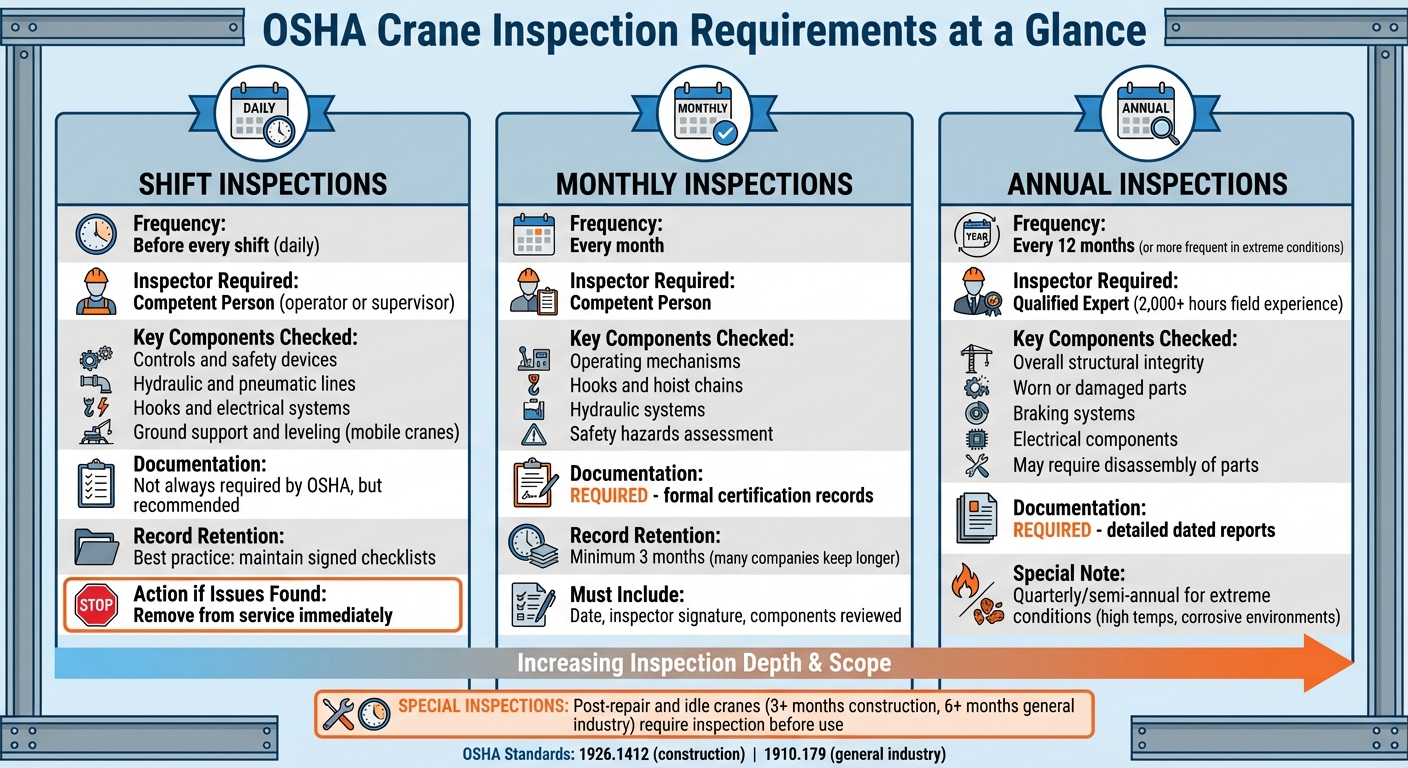
OSHA Crane Inspection Types: Frequency, Inspector Requirements, and Documentation Standards
OSHA has outlined a tiered inspection process to ensure cranes operate safely and meet compliance standards. Each level of inspection serves a specific purpose in identifying and addressing potential safety concerns.
Shift Inspections
Before every shift, a competent person - usually the crane operator or supervisor - must carry out a thorough inspection. This involves checking the crane's controls, safety devices, hydraulic and pneumatic lines, hooks, and electrical systems. For mobile cranes, it's also essential to confirm that the ground support is stable and the equipment is properly leveled.
"Cranes being used in steel erection activities shall be visually inspected prior to each shift by a competent person; the inspection shall include observation for deficiencies during operation." - OSHA Standard 1926.753
If any issues are discovered during the inspection, the crane must be taken out of service immediately until repairs are made. While OSHA doesn’t always require written records for these daily inspections, maintaining a signed and dated checklist is a smart practice. It can help reduce liability and demonstrate compliance during reviews or audits. This daily inspection acts as the first line of defense before moving on to more detailed evaluations.
Monthly Inspections
Monthly inspections go a step further, requiring formal documentation. These inspections focus on operating mechanisms, hooks, hoist chains, and hydraulic systems. OSHA mandates that employers keep certification records, which must include the inspection date, the inspector’s signature, and the specific components reviewed. These records must be retained for at least three months, although many companies hold onto them longer to track wear and tear over time.
A competent person should perform these checks, and any identified safety hazards must be addressed before the crane is used again. The insights gained from these monthly inspections play a crucial role in preparing for the more extensive annual evaluations.
Annual Inspections
Annual inspections are the most detailed and must be conducted by a qualified expert. These inspections examine the crane’s overall structural integrity, looking for worn or damaged parts, assessing braking systems, and inspecting electrical components. In some cases, parts like gear cases or bearing enclosures may need to be disassembled to detect hidden defects.
"Complete inspections of the crane shall be performed at intervals... depending upon its activity, severity of service, and environment." - OSHA Standard 1910.179(j)
For cranes operating under extreme conditions - such as high temperatures or corrosive environments - inspections might be required more frequently, on a quarterly or semi-annual basis. These inspections must include detailed, dated reports to meet compliance standards. Inspectors conducting annual evaluations are expected to have significant experience, with at least 2,000 hours of fieldwork in maintenance, repair, and functional testing.
Post-Repair and Idle Crane Inspections
Cranes don’t run continuously; they often face periods of repair or extended idling. Before getting back to work, these machines require thorough safety inspections. While routine shift, monthly, and annual checks are standard, specific protocols are necessary after repairs or inactivity to ensure safe operation.
Post-Repair Inspections
Any time a crane undergoes repairs or modifications that could impact safety, it must be inspected by a qualified professional before being used again. This includes work on safety devices, control systems, braking systems, load-bearing structures, or power sources.
"Equipment that has had a repair or adjustment that relates to safe operation... must be inspected by a qualified person after such a repair or adjustment has been completed, prior to initial use." - OSHA 1926.1412(b)
The inspection should cover all repaired components and any related systems to confirm they are functioning correctly. If modifications have been made, the inspector must verify that these changes meet approved equipment modification standards. When manufacturer standards are unavailable, a Registered Professional Engineer (RPE) must establish repair criteria to ensure the crane’s load capacity and structural integrity remain intact.
For cranes that have been sitting idle, inspections are just as critical.
Idle Crane Inspections
OSHA regulations specify different inspection requirements based on how long a crane has been out of service. Construction cranes idle for three months or more must undergo a monthly-equivalent inspection, as per OSHA 1926.1412. General industry cranes that have been idle for over six months require a complete inspection, per OSHA 1910.179.
"A crane which has been idle for a period of over 6 months shall be given a complete inspection... before placing in service." - OSHA 1910.179
These inspections are essential to identify potential issues caused by factors like corrosion, lubricant breakdown, or exposure to harsh environments. It’s important to document all inspection details, including items checked, dates, and signatures, and retain these records for at least three months. Inspections are particularly crucial in corrosive environments, where damage can occur more quickly.
For expert guidance, TDS Erectors & Crane Service ensures all inspections comply with OSHA standards, helping keep your equipment safe, reliable, and ready for operation.
sbb-itb-6be7c12
Inspector Qualifications and Record Requirements
Having skilled inspectors is essential for maintaining safety standards. While OSHA doesn’t require certification from a specific agency, inspectors must meet qualification standards tailored to the type of inspection they’re conducting.
Inspector Qualifications
Although formal certification isn’t mandated by OSHA, inspectors must show expertise appropriate to the inspection type. For routine shift and monthly inspections, a competent person is required - someone with the authority to address safety concerns immediately. Typically, this could be an experienced operator or supervisor familiar with the equipment.
For more complex inspections, such as annual evaluations, post-repair checks, or assessments of modified equipment, a qualified person is necessary. This is defined as someone with a recognized degree, certification, professional standing, or extensive training and knowledge, along with demonstrated skill in crane inspections. These inspectors should have at least 2,000 hours of field experience and a solid understanding of safety codes, equipment specifications, and relevant terminology.
"Crane inspectors are not required to be certified. They must, however, possess a level of expertise that is based on the complexity and type of inspections they perform." - OSHA
When verifying qualifications, ensure that inspectors handling annual or post-repair inspections meet the qualified person criteria through formal education and proven work experience.
Once inspectors meet these standards, maintaining proper documentation becomes critical for compliance.
Recordkeeping Best Practices
Thorough documentation is not only an OSHA requirement but also a key tool for defending against audits. Inspection records must be written, signed, and dated, clearly noting the inspection date and any identified deficiencies.
"The records should be signed and dated by the inspector to validate the inspection done. All frequent inspections must be kept in good detail." - Sitemate
Organize inspection records in a reliable system, whether physical or digital, to ensure easy access during audits. Digital tools can enhance this process by providing automatic time-stamping, photographic evidence of defects, and protection from physical damage or loss. Retain inspection records for a minimum of three months, and keep monthly certification records for critical components like hoist chains and hooks.
Before starting a new inspection, review past reports to identify recurring issues or components that have undergone major repairs. If a hazard is discovered during an inspection, document it immediately and remove the equipment from service until the issue is resolved and verified. Companies like TDS Erectors & Crane Service maintain detailed inspection records and employ qualified personnel to ensure compliance with OSHA standards.
CMAA Specification 78 and Compliance Strategies
CMAA Specification 78 Updates for 2025
As OSHA updates continue to align with evolving industry standards, CMAA Specification 78 serves as a modern framework for crane safety. The Crane Manufacturers Association of America (CMAA) has introduced CMAA Specification No. 78 - 2025 - Professional Services, designed to bring crane inspection practices in line with current technological advancements. This specification works alongside OSHA regulations, offering detailed technical guidance. Under OSHA 1910.6, privately developed standards like CMAA Specification 78 hold the same authority as OSHA standards.
The 2025 updates focus on integrating modern technologies, such as automation, digital controls, variable frequency drives (VFDs), and programmable logic controllers (PLCs) for motion control. They also emphasize lifecycle design principles and performance monitoring to assess the service life of crane components. Importantly, subjective language has been replaced with measurable criteria. For example, inspectors are now required to have at least 2,000 hours of field experience and must complete biennial training updates.
"Spec 78 was written with a primary purpose to recognize overhead traveling crane service... as an industry worthy of having guidelines and standards for providing high quality, professional services performed by safety-minded, manufacturer-trained and certified technicians." - Dan Beilfuss, Representative, CMAA
Another significant change is the recommendation for periodic load testing. While OSHA 1910.179(k) mandates load testing for new, repaired, or modified cranes, CMAA Specification 78 now advises load testing of in-service cranes every four years to detect structural fatigue. Additionally, the specification requires that written inspection reports be kept for the entire lifespan of the equipment.
These updates reflect a commitment to blending advanced technology with rigorous inspection practices, paving the way for stronger compliance strategies.
Compliance Strategies for Employers
To meet both OSHA and CMAA standards, employers need a structured approach to training, documentation, and inspections. Start by verifying that inspectors meet the 2,000-hour field experience requirement for annual and periodic inspections. When working with third-party inspection services, confirm that they comply with CMAA Specification 78 qualifications and maintain up-to-date biennial training records.
Create a biennial training schedule for all inspection and maintenance staff to ensure compliance with CMAA Specification 78. If the original manufacturer’s manual for your crane is unavailable, CMAA Specification 78 offers detailed checklists to identify critical systems and components for inspection. These checklists go beyond OSHA’s general guidelines and include specialized resources like runway alignment charts and root cause analysis tools.
Switch to digital recordkeeping for better organization and faster audit responses. Digital systems allow you to store inspection logs, inspector credentials, and photographic evidence of defects, all with automatic time-stamping and protection against physical damage. Maintaining active records of each inspector’s certifications and expertise is crucial, as OSHA’s 2025 standards require employers to document inspectors’ qualifications. For example, companies like TDS Erectors & Crane Service utilize digital records and employ OSHA-certified operators who meet CMAA standards, ensuring compliance across multiple states.
Finally, implement a four-year load-testing cycle for all in-service cranes, as recommended by CMAA Specification 78. This includes static testing at 125% of the crane’s rated capacity for 10 minutes and dynamic testing at 110% capacity for at least one hour. These protocols reinforce the goal of consistent, thorough safety monitoring throughout the crane’s operational life.
Conclusion
Crane inspections play a key role in maintaining safety and ensuring smooth operations. OSHA's inspection requirements are designed to protect workers and prevent disruptions caused by equipment failures. Regular checks help identify potential issues early, reducing the risk of accidents and costly downtime.
Compliance with OSHA standards, such as 29 CFR 1910.179 and Standard 1926.753, is critical to avoid injuries and penalties. These guidelines outline the need for both routine and specialized inspections and empower operators to halt operations if safety concerns arise. Inspection frequency should be adjusted based on the operating environment and service demands, as visual checks alone may not be sufficient for heavily stressed components.
Proper documentation of inspections, including dates, signatures, and detailed component information, is crucial for audits. For example, under Cal/OSHA regulations, records must be kept for a minimum of 48 months.
To meet these rigorous standards, consider working with skilled service providers like TDS Erectors & Crane Service. They offer OSHA-certified operators, thorough inspections, and detailed recordkeeping to keep your cranes safe and compliant across their service lifespan.
"Through regular inspections, crane users can spot potential problems so they can perform maintenance and repairs that may preclude employee injury and costly interruptions in service." - Konecranes
FAQs
What qualifications are required to inspect cranes under OSHA guidelines?
To perform crane inspections, OSHA stipulates that the individual must qualify as a competent person under Subpart CC. This means they should possess the knowledge, training, and experience needed to identify hazards and determine when corrective actions are required. For steel-erection tasks, OSHA specifically requires a visual inspection of cranes before each shift by a competent person. These inspections focus on critical aspects such as control mechanisms, signs of wear, lubrication, and any other visible issues.
Inspectors are expected to have documented experience with the specific crane type they are evaluating. They also need formal training on OSHA's inspection standards and the expertise to judge whether the equipment is safe for use or requires repairs. Employers generally confirm these qualifications through internal training, accredited courses, or relevant work experience that meets OSHA's criteria.
How often does OSHA require cranes to be inspected?
OSHA mandates that cranes undergo inspections at specific intervals to maintain safety and compliance. A daily pre-shift visual inspection is required at the beginning of each work shift. Beyond that, frequent inspections should take place on a daily, weekly, or monthly basis, depending on how often the equipment is used and the conditions it operates under. For a more in-depth check, periodic inspections must be conducted every 1 to 12 months, which could mean quarterly or annually.
These inspections play a key role in spotting potential problems early, helping to create a safer work environment. Adhering to OSHA's guidelines not only minimizes compliance risks but also protects your equipment and team.
What records are needed to meet OSHA's crane inspection requirements?
To meet OSHA's crane inspection standards, every inspection - whether it’s done per shift, monthly, or annually - needs to be recorded in a written report. These reports must be signed by a competent or qualified inspector and retained for specific durations: at least 3 months for monthly inspections and 12 months for annual inspections. Additionally, these records must be easily accessible for OSHA review if requested. Keeping thorough documentation is essential for adhering to regulations such as 1926.1412(f)(7) and 1926.1412(e)(3).
Related Blog Posts
Blogs, calculators, and other content on the TDS blog is for educational purposes only and does not constitute crane or rigging advice. For information specific to your situation, please contact us for an estimate or consultation.
Related Articles

Load Calculator
Quickly calculate total load, capacity limits, safety margins, and axle estimates for lifting, transport, and everyday load planning.

NCCCO Certification Training: Why Working With a Trainer Helps You Get Certified
Trainer-led NCCCO prep combines tailored study, hands-on seat time, and exam strategies to boost pass rates and launch higher-paying crane careers.

Ultimate Guide to Welding Inspection and Quality Control
Comprehensive guide to welding inspection and quality control: pre-weld checks, in-process monitoring, post-weld NDT, WPS/PQR compliance, and records.