
Ultimate Guide to Welding Inspection and Quality Control
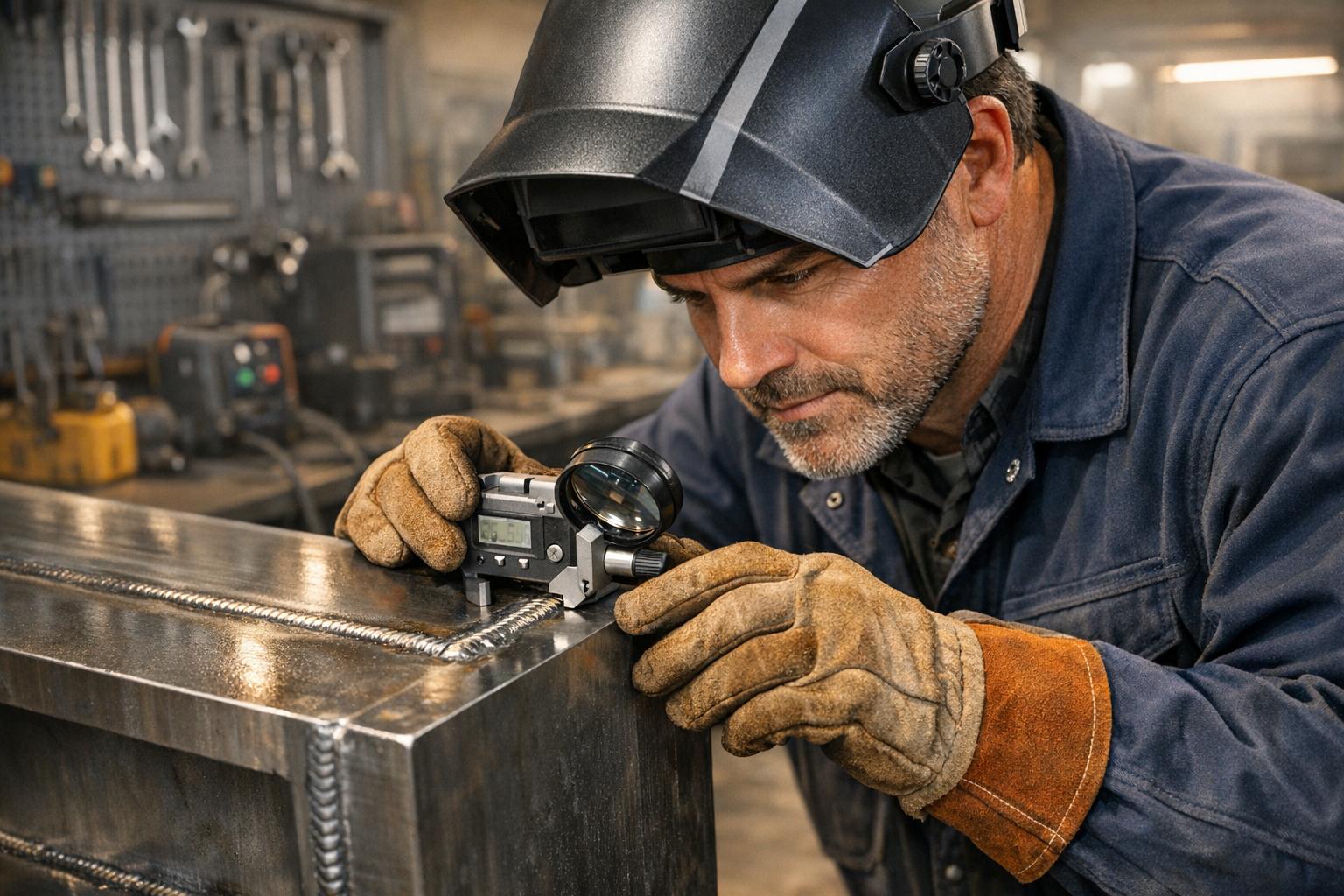
Welding inspection and quality control ensure the safety and reliability of welded structures like bridges, buildings, and pipelines. This process involves checking materials, monitoring welds during production, and conducting post-weld inspections to meet strict industry standards like AWS D1.1 and ASME Section IX. Here's what you need to know:
- Why It Matters: Prevents weld failures, ensures safety, and avoids costly rework.
- Key Steps:
- Pre-weld: Verify materials, joint preparation, and welder qualifications.
- During welding: Monitor parameters, clean surfaces, and perform real-time inspections.
- Post-weld: Conduct visual and non-destructive tests (e.g., ultrasonic, radiographic).
- Certified Inspectors: Certified Welding Inspectors (CWIs) play a critical role in verifying compliance and maintaining quality.
- Documentation: Detailed records, including Welding Procedure Specifications (WPS) and inspection reports, are essential for accountability and process improvement.
This guide outlines each step of the inspection process, explains testing methods, and highlights the importance of compliance with standards to ensure weld integrity and project success.

Welding Inspection Quality Control Process: Pre-Weld, During, and Post-Weld Steps
The Ultimate Weld Inspection Checklist: Episode 3
What Is Welding Quality Control?
Welding quality control focuses on identifying and fixing weld defects through inspections, testing, and audits. While quality assurance (QA) takes a proactive approach by establishing standards and procedures to prevent issues, quality control (QC) ensures the finished weld meets those standards.
The Welding Institute clarifies this difference:
Quality assurance (QA) – is associated with the implementation of standards (such as ISO 9000) during the production stage. Quality control (QC) – is associated with verifying quality requirements via inspections.
This distinction highlights why QC is so critical in welding. QA sets the rules, and QC ensures those rules are followed, catching flaws early to prevent costly or dangerous failures.
Why Quality Control Matters in Welding
Welding quality control isn't just a box to check - it’s a safeguard for both lives and investments. Poor QC can lead to catastrophic weld failures, which, in critical structures like bridges, pipelines, or pressure vessels, could result in severe risks to human safety and structural stability. For example, industry codes like AWS D1.1 enforce a strict zero-tolerance policy for cracks, meaning any crack - no matter how small - is unacceptable.
Investing in quality control also makes financial sense. By catching defects during the welding process rather than after project completion, companies can reduce maintenance costs, avoid downtime, and limit liability for faulty products. For materials like high-strength steels (e.g., ASTM A514 or A517), inspections are crucial and must be done no less than 48 hours after welding to detect delayed hydrogen-induced cracking, ensuring long-term safety.
Thorough QC documentation and verification are equally important to meet the standards set by organizations like AWS, ASME, and ISO. These steps ensure structures meet regulatory requirements and receive final approval for use.
Core Components of Welding Quality Control
Welding QC happens in three key stages:
- Before Welding: Confirming material properties, equipment readiness, and proper joint preparation.
- During Welding: Monitoring welding parameters and ensuring surfaces are cleaned appropriately.
- After Welding: Performing visual inspections and using non-destructive testing methods.
Visual inspections are the first step in spotting surface issues like irregularities or cracks. For deeper or hidden defects, non-destructive testing methods such as radiography, magnetic particle testing, and ultrasonic testing come into play. These techniques are essential for meeting AWS D1.1 standards.
The importance of these methods is reflected in market trends. The global Non-Destructive Testing market is projected to grow to $22.34 billion by 2030. Additionally, acceptance criteria for welds can vary depending on a structure’s load conditions. For example, in cyclically loaded structures like bridges, stricter standards may apply. In some cases, undercut in primary members under tensile stress is limited to just 0.01 inches.
Quality Control Before Welding Begins
Quality control plays a crucial role in preventing weld failures, and the checks conducted before welding starts are especially important. Addressing potential issues early on saves time and money, as correcting mistakes after welding begins is far more challenging and expensive. Pre-weld quality control focuses on three primary areas: verifying materials, inspecting joint preparation, and ensuring welder qualifications.
Verifying Material Properties
The first step is confirming that the base metal meets the required specifications, such as ASTM A709 Grade 36, 50, or 50W for structural steel projects. For materials up to 4 inches thick, surface roughness should typically not exceed 1,000 µin. It's equally important to ensure that the filler metal and electrodes match the base material. Using incompatible materials can create weak spots, increasing the risk of failure. Once materials are verified, the next step is to focus on preparing the weld joint for success.
Joint Preparation and Fit-Up Inspection
Proper joint preparation directly affects the quality and strength of the weld. Inspectors review engineering drawings to confirm that joint designs, welding symbols, and any special instructions are correctly understood. Before welding begins, all contaminants like rust, oil, moisture, and grease must be removed from the surface to avoid defects such as porosity or lack of fusion.
Fit-up accuracy is another critical factor. Inspectors check root openings and joint angles to ensure proper alignment and prevent incomplete penetration, which occurs when the base and filler metals fail to fuse at the root of the joint. Even small deviations can weaken the weld and jeopardize the structure's overall integrity. After setting up the joint, the next focus shifts to verifying the skills and qualifications of the welders.
Checking Welder Qualifications
Ensuring that welders are properly qualified is key to avoiding structural failures and unnecessary rework. Each welder must hold certifications that align with the project's specific materials, joint types, and welding techniques. Poor welding practices or incorrect procedures can lead to defects that compromise the weld's durability, causing delays and increasing costs.
Certified Welding Inspectors (CWIs) play a vital role in this process. They oversee welder qualifications by witnessing test specimens and ensuring compliance with the Welding Procedure Specification (WPS). Before production welding begins, test coupons from welders undergo physical testing - such as tensile, bend, and nick break tests - to confirm mechanical strength. For large-scale or remote projects, mobile testing trailers can be deployed to qualify welders on-site, minimizing delays.
Inspection During the Welding Process
Real-time inspections during welding are crucial for catching defects as they happen, helping to avoid costly repairs and project delays. The Welding Procedure Specification (WPS) acts as the cornerstone document guiding all welding operations, and inspections are conducted in alignment with its guidelines. Let’s dive into how monitoring parameters, cleaning, and in-process testing ensure weld quality.
Tracking Welding Parameters
Inspectors and technicians play a critical role in ensuring that welding stays within the WPS requirements. This involves keeping an eye on factors like electrode size, equipment settings, and necessary temperatures. To maintain compliance with industry standards, such as those set by the American Welding Society (AWS), AREMA, and AISC, a Certified Welding Inspector (CWI) or a skilled welding technician should oversee these procedures. Additionally, real-time quality control programs verify that the work meets project specifications as it progresses.
Cleaning and Pass Verification
After each welding pass, it’s essential to remove slag, rust, dirt, grease, and spatter. These residues can obscure potential flaws, such as undercut or porosity, making thorough cleaning mandatory. Welders must visually inspect and address issues like lack of fusion or undercut before moving on to the next pass. This is particularly important for the root pass in multipass welds, as it solidifies quickly and is prone to cracking or trapping gas and slag. Proper cleaning and inspection of this initial layer are key to maintaining the weld’s overall integrity. Beyond cleaning, non-destructive testing methods provide additional assurance during the welding process.
Non-Destructive Testing During Welding
Visual inspections are fundamental for spotting surface defects at every stage. Charles Hayes, International Sales/Support Manager at The Lincoln Electric Co., highlights the importance of early detection:
Repair costs can be minimized if visual inspection detects these flaws before welding progresses.
For deeper analysis, Magnetic Particle Testing (MT) is used between passes to uncover surface and near-surface cracks that might otherwise be hidden. In applications like pipe welding, real-time radioscopy offers immediate radiographic images, allowing for quick identification and correction of internal defects. However, avoid shotblasting before inspections, as it can obscure fine cracks.
Inspection and Testing After Welding
Once welding is complete, inspections ensure the weld meets all necessary standards and is ready for its intended purpose. This process involves a mix of visual checks, advanced non-destructive techniques, and sometimes destructive testing to confirm the weld's structural soundness and compliance with project specifications. These inspections build on earlier checks, ensuring both surface and internal weld quality.
Visual Inspection Methods
Direct Visual Inspection (DVI) is the most widely used method, relying on the human eye and basic tools like 10x magnifying glasses, mirrors, and flashlights to detect surface flaws such as cracks, porosity, or misalignment. Bruce Crouse, a VT Level III expert at ASNT, highlights the inspector's role:
In visual testing, the inspector is the instrument that evaluates the part.
For accurate results, inspections should be conducted within 24 inches of the weld and at an angle of at least 30° to avoid distortion. Clean surfaces are essential to expose any defects. Dimensional inspection involves tools like fillet weld gauges, calipers, and rulers to confirm that leg sizes, throat thickness, and lengths adhere to design specifications. For areas that are hard to access, such as the interiors of pipes or offshore structures, Remote Visual Inspection (RVI) uses equipment like borescopes, videoscopes, drones, and robotic cameras. On production lines, Automated Visual Inspection (AVI) is becoming more common. This method uses AI-powered software and high-resolution cameras to quickly assess welds, reducing human error while maintaining efficiency.
Non-Destructive Testing (NDT) Methods
When visual inspection alone isn't enough, non-destructive testing methods can uncover internal or subsurface flaws without damaging the weld.
- Ultrasonic Testing (UT) uses high-frequency sound waves that reflect or scatter when they encounter internal defects like cracks, lack of fusion, or slag inclusions. Linear phased array ultrasonic scanning, a more advanced version, is 5–10 times faster than manual UT, though a complete system can cost around $60,000.
- Radiographic Testing (RT) employs X-rays or gamma rays to create an image of the weld. Variations in material density show up on film, revealing voids or inclusions. However, safety precautions require cordoning off an area within 25 to 75 feet, depending on the radiation source.
- Magnetic Particle Testing (MT) is effective for ferromagnetic materials. By magnetizing the weld, it identifies surface or near-surface flaws through "leakage fields", which attract iron particles and make defects visible. After testing, components must be demagnetized to prevent interference with future machining.
- Liquid Penetrant Testing (PT) uses capillary action to draw visible or fluorescent dye into surface cracks. After a dwell time of 5 to 60 minutes, a developer is applied, and at least 10 minutes are needed for the dye to emerge fully from cracks.
Destructive Testing for Procedure Qualification
Destructive testing is often used to qualify welding procedures, verify material properties, or confirm that a welder can produce reliable welds. Charles Hayes of The Lincoln Electric Co. explains:
Destructive tests definitively confirm weld serviceability.
- Bend testing assesses ductility and soundness by bending a specimen to a specified radius. If cracks or discontinuities exceed code limits (e.g., AWS D1.1 or ASME Section IX), the weld fails.
- Transverse tension testing measures the actual load and tensile strength. A successful test typically results in failure of the base metal rather than the weld, proving the weld’s strength exceeds that of the joined parts.
- Macroetch testing involves cutting through the weld, cleaning the surface, and applying acid to expose the weld cross-section. This method is especially useful for evaluating fillet welds that are hard to assess with bend tests.
- Nick-break testing creates a controlled fracture at a specific point by making a cut perpendicular to the weld. This allows for visual inspection of the internal weld structure.
These destructive techniques are primarily reserved for procedure qualification and pre-production testing with full-scale mockups.
sbb-itb-6be7c12
Welding Procedure Specification (WPS) and Compliance
Continuing from earlier discussions on quality control, the Welding Procedure Specification (WPS) and its validation through Procedure Qualification Records (PQRs) are essential for maintaining consistent weld quality.
What Is a WPS?
A Welding Procedure Specification (WPS) is a detailed document that outlines all the necessary parameters for welding. It includes specifics like the welding process, base and filler materials, joint design, position, preheat requirements, shielding gas, and electrical settings. It also distinguishes between essential and supplementary variables.
The goal of a WPS is simple: to ensure that every weld meets the required strength, ductility, and toughness for its intended use - whether it's for a pressure vessel, a bridge, or a pipeline. Compliance with industry standards such as ASME Section IX or AWS D1.1 is often a legal requirement, mandating that welding must follow qualified procedures. While the WPS ensures the process is qualified, a separate document, the Welder Performance Qualification (WPQ), certifies the welder's ability to perform the procedure. To validate the WPS, a Procedure Qualification Record (PQR) is also required.
Procedure Qualification Records (PQR)
The Procedure Qualification Record (PQR) is the backbone of a WPS, serving as its validation document. It records the variables used during test welds and their results, proving that the procedure is reliable and effective.
Under ASME Section IX, which governs pressure vessels and power piping, no welding procedure is "prequalified." Every WPS must be backed by its own PQR. However, AWS D1.1, which applies to structural welding, permits "prequalified" WPSs for common joint configurations and materials. These prequalified procedures don't require PQR testing as long as specific rules are strictly followed. For instance, a typical PQR for a groove weld under AWS D1.1 involves two transverse tensile tests and four guided bend tests.
Inspectors play a crucial role in ensuring compliance. They must verify that the essential variables listed in the PQR align with the ranges specified in the WPS. While welders need access to the WPS during welding, the PQR is primarily for the inspector's review. If any essential variable - such as the type of base material, welding process, or filler metal - exceeds the limits allowed by the applicable code, the WPS must be re-qualified with a new PQR. Using third-party ISO/IEC 17025 accredited laboratories for PQR testing adds an extra layer of impartiality and ensures accurate mechanical test results.
Industry Standards for Welding Inspection
Welding inspections are guided by established industry standards that set clear parameters for quality and safety. These standards ensure welds are reliable, meet strict safety requirements, and perform as expected throughout their lifespan. Following these guidelines is critical to maintaining consistency and meeting the high benchmarks set during a project's initial phases. The American Welding Society (AWS) alone has developed over 350 welding standards, with contributions from more than 200 technical committees and 1,500 volunteers. These standards play a key role in reinforcing the quality control practices discussed earlier. Below are some of the most important standards:
AWS D1.1: Structural Welding Code
The AWS D1.1/D1.1M:2025 standard is the go-to reference for welding steel structures like buildings and bridges. It mandates visual inspection for all welds unless an engineer specifies otherwise and enforces a strict zero-tolerance policy for cracks. The 2025 edition introduces advanced techniques such as digital radiography and Phased Array Ultrasonic Testing (PAUT). It also limits undercut in primary members subjected to tensile stress to 0.01 in. (0.25 mm) for cyclically loaded structures. For high-strength steels like ASTM A514 or A709 Grade 100, the standard requires a 48-hour delay before final visual inspection to identify delayed hydrogen cracking. Additionally, AWS D1.8/D1.8M:2025 provides specialized guidelines for welding in Seismic Force Resisting Systems, ensuring structural safety during earthquakes.
ASME Section IX: Welding Qualifications
ASME Section IX focuses on qualifying welding procedures and personnel, particularly for pressure vessels and pipelines. Unlike AWS D1.1, this standard requires that each Welding Procedure Specification (WPS) be supported by a Procedure Qualification Record (PQR), with no exceptions allowed.
ISO 3834: Quality Requirements for Welding
While AWS D1.1 and ASME Section IX address specific structural and procedural aspects, ISO 3834 takes a broader approach by focusing on a manufacturer’s overall quality management system. This international standard outlines the quality requirements for fusion welding, emphasizing a company’s ability to meet specified quality levels rather than setting weld acceptance criteria for individual products. Industries like aerospace and energy, where welding reliability is critical, often rely on ISO 3834. The standard defines three quality levels - Comprehensive, Standard, and Elementary - and is frequently paired with product-specific standards like ISO 5817 for weld acceptance criteria.
| Standard | Primary Focus | Key Application | Inspection Approach |
|---|---|---|---|
| AWS D1.1 | Structural steel integrity | Buildings, bridges | 100% visual inspection; strict acceptance criteria |
| ASME Section IX | Procedure and personnel qualification | Pressure vessels, pipelines | Test coupon qualification; no prequalified procedures |
| ISO 3834 | Quality management system | Aerospace, energy, global manufacturing | Process control and manufacturer capability assessment |
The Role of Certified Welding Inspectors
Certified welding inspectors play a key role in bridging welding operations with quality assurance. They ensure that every weld adheres to industry codes, prioritizing safety and compliance.
Inspector Qualifications and Certifications
To take on this responsibility, inspectors must earn the Certified Welding Inspector (CWI) credential from the American Welding Society (AWS), which is considered the gold standard in the U.S. welding industry. As AWS explains:
The AWS Certified Welding Inspector (CWI) credential is a mark of distinction in the welding field, demonstrating a thorough grasp of welding processes and standards.
Becoming a CWI requires meeting specific education and experience benchmarks. For example, a high school graduate needs five years of welding-related work experience, while someone with a bachelor's degree in welding engineering needs just one year. Additionally, candidates must pass a vision test and score at least 72% on each of three exam sections: Part A (Fundamentals), Part B (Practical), and Part C (Code Book). The certification is valid for nine years, with mandatory renewals at three and six years.
| Education Level | Work Experience |
|---|---|
| Bachelor's degree in welding engineering/technology | 1 year |
| Associate degree in engineering or physical science | 2 years |
| Trade/vocational courses (completed) | 4 years |
| High school diploma or equivalent | 5 years |
| 8th grade education | 9 years |
The initial certification cost ranges from $1,255 for AWS members to $1,520 for non-members, with renewal fees of $630 and $895, respectively. To further enhance their qualifications, inspectors can pursue endorsements in specialized areas like AWS D1.5 (Bridge) or API 1104 (Pipeline).
What Welding Inspectors Do
Welding inspectors are responsible for ensuring that all welding adheres to the project’s Welding Procedure Specifications (WPS) and Procedure Qualification Records (PQR). Their first task is a visual inspection of welds to identify issues like cracks, porosity, undercut, or lack of fusion before any additional testing begins. This proactive approach helps reduce costly rework and prevents structural failures.
For projects involving high-strength steels, such as ASTM A514 or A709 Grade 100, inspectors conduct a 48-hour post-weld inspection to check for delayed hydrogen-induced cracking. They rely on tools such as fillet weld gauges, undercut gauges, magnifiers (minimum 5x), and strong lighting to assess weld profiles against code tolerances. Findings are documented according to standards like AWS D1.1 Table 8.1, supporting quality control audits.
In cases of cyclically loaded structures, such as bridges, inspectors apply stricter standards. For example, undercut in primary members under tensile stress must not exceed 0.01 inches (0.25 mm) to prevent fatigue failure. Inspectors also work closely with non-destructive testing (NDT) technicians for methods like ultrasonic or radiographic testing, ensuring thorough quality verification throughout the welding process.
Documentation and Record-Keeping
Accurate documentation is the backbone of welding quality control, capturing every detail from material selection to the final inspection process. These records ensure welders stay within their qualification limits and provide accountability through contractor signatures. They also help management confirm that all work aligns with contract requirements and industry standards. Below, we explore the key documentation practices that not only uphold quality but also drive continuous improvement.
Required Welding Documentation
A thorough documentation process includes several critical components:
- Welder Certifications: These confirm that welders meet the required standards and remain valid for three years.
- WPSs (Welding Procedure Specifications): These outline the specific methods and practices - such as filler metal selection, current settings, and joint design - used for particular materials.
- PQRs (Procedure Qualification Records): These document the tests conducted to validate welding procedures.
In addition, projects must include Non-Destructive Testing (NDT) reports - like radiography, magnetic particle, or ultrasonic tests - along with material test reports that verify base metal properties (e.g., ASTM A709 Grade 36 or 50). Inspector certifications must also be part of the documentation.
Before production begins, fabricators compile a "welding book" that includes weld identification, tracking tables, PQRs, and WPSs. Once the project is complete, a Manufacturer/Builder record should detail the entire manufacturing history, including NDT results, material certificates, and any non-conformity follow-ups. This meticulous record-keeping process ensures safety, accountability, and compliance with strict quality control standards. These records not only confirm adherence to requirements but also serve as a foundation for improving processes over time.
Using Records to Improve Quality
Documentation goes beyond meeting compliance - it’s a tool for refining and enhancing quality. The Iowa Department of Transportation highlights this point:
Early radiographic inspection is highly desirable, followed by less frequent inspection once the welder has proven their consistent ability.
By analyzing inspection data, quality managers can adjust testing frequencies based on a welder’s proven performance. This approach helps reduce costs while maintaining safety and reliability.
Inspectors are encouraged to maintain detailed personal notes about their work to ensure accuracy and provide valuable data for engineers. Many modern fabrication shops now use welding management software to streamline these processes. These tools help centralize qualification management, track welder and procedure qualification renewal dates, and quickly trace defect origins by reviewing the manufacturing history. This digital tracking can reveal patterns in dimensional inconsistencies, structural issues, or recurring problems tied to specific welders or procedures.
The AISC Program Guidelines also stress the importance of training documentation:
The company shall document the training and skill levels of its employees through completion of training programs and/or field experience.
Conclusion
Welding inspection and quality control play a critical role in ensuring safe, compliant, and reliable fabrication. From verifying materials before welding to conducting post-weld non-destructive testing, each step is designed to prevent failures, maintain structural integrity, and meet stringent industry standards like AWS D1.1 and ASME Section IX.
By adhering to these rigorous processes, certified professionals ensure that quality is never compromised. As Kent Inspection & Engineering emphasizes:
Our team of Professional Engineers, Certified Welding Engineer and Inspectors, and Certified Crane Inspectors help create safe, compliant, and efficient solutions for our clients' everyday needs.
- Kent Inspection & Engineering
This level of expertise ensures that raw data is transformed into actionable insights, identifying causes and solutions with precision.
The integration of artificial intelligence and advanced technologies is revolutionizing non-destructive testing. As these innovations evolve, continuous training and certification become essential for maintaining competitive quality standards. Companies that embrace these advancements position themselves for sustained success.
For businesses in the 4-state region seeking commercial fabrication and welding services, working with experienced providers who prioritize safety and quality is key. TDS Erectors & Crane Service offers certified expertise and tailored solutions, ensuring every weld meets exacting inspection standards. Their dedication to OSHA compliance and thorough quality control processes helps clients achieve the reliability and performance their projects demand. This comprehensive approach underscores the importance of maintaining superior weld standards at every phase of the process.
FAQs
What’s the difference between welding quality control and quality assurance?
Welding quality control (QC) is all about the hands-on inspection and testing of welds during the fabrication process. This includes tasks like visual inspections, radiographic testing, and ultrasonic testing, which are carried out before, during, and after welding. The goal? To make sure every weld meets the required codes and standards.
On the flip side, welding quality assurance (QA) takes a broader approach. It’s a management system focused on creating and maintaining the procedures, documentation, and requirements needed to ensure the entire welding process aligns with regulatory and contractual standards. QA involves tasks like setting qualifications, approving welding procedures, and auditing the QC system itself, rather than inspecting individual welds.
To sum it up: QC focuses on individual welds to ensure they meet standards, while QA oversees the bigger picture, ensuring the entire quality control process is effective and compliant.
How do Certified Welding Inspectors ensure welding meets safety and quality standards?
Certified Welding Inspectors (CWIs) are essential in maintaining the safety and quality of welding projects. Their work begins with a thorough review of project specifications, blueprints, and applicable codes - such as AWS D1.1 - to ensure every requirement is understood and accounted for.
CWIs verify that welding procedures, welder certifications, and materials align with the required standards. They conduct visual inspections and, when necessary, perform nondestructive testing at various stages: before, during, and after welding. These inspections are designed to catch defects or inconsistencies, ensuring the welds meet the code’s acceptance criteria. Afterward, CWIs meticulously document their findings, clearly noting whether the welds meet the standards or need corrective actions to achieve compliance.
Why is non-destructive testing important in welding inspection?
Non-destructive testing (NDT) plays a key role in welding inspection, as it checks the quality and reliability of welds without harming the material. This method helps uncover internal or surface defects that might affect safety, performance, or compliance with industry regulations.
Spotting issues early through NDT means problems can be addressed before they lead to expensive repairs or failures down the line. It also confirms that welds meet safety and quality standards, making it a critical step in any welding quality control process.
Related Blog Posts
Blogs, calculators, and other content on the TDS blog is for educational purposes only and does not constitute crane or rigging advice. For information specific to your situation, please contact us for an estimate or consultation.
Related Articles
Steel Fabrication Unit Converter
Convert steel fabrication units fast—weight, length, area, and volume with accurate formulas, clean results, and a handy reference table.
How to Choose the Right Crane for Your Project
Selecting the right crane for your project is essential for safety, efficiency, and cost management. Learn how to evaluate your needs and site conditions.

Construction Safety Checklist Generator
Create customized safety checklists for construction sites with our free generator. Select project type and tasks for OSHA-aligned lists in seconds!