
Crane Accident Reporting: OSHA Compliance Guide

Crane accidents must be reported to OSHA within strict deadlines to avoid penalties and ensure workplace safety. Fatalities must be reported within 8 hours, while in-patient hospitalizations, amputations, or eye losses must be reported within 24 hours. Employers - not employees - are responsible for ensuring compliance. Reports can be filed through OSHA's hotline, local offices, or an online form.
Key points:
- Reportable incidents: Work-related fatalities, in-patient hospitalizations, amputations, or eye losses.
- Deadlines: 8 hours for fatalities, 24 hours for other incidents.
- Reporting methods: Call 1-800-321-6742, contact a local OSHA office, or submit online at osha.gov.
- State-specific rules: 22 states with OSHA-approved plans may have additional requirements.
Employers should have clear systems for identifying and reporting incidents, documenting safety measures, and maintaining compliance with both federal and state regulations. Accurate record-keeping and regular inspections are essential to avoid fines, which can range from $16,550 to $165,514 depending on the violation type.
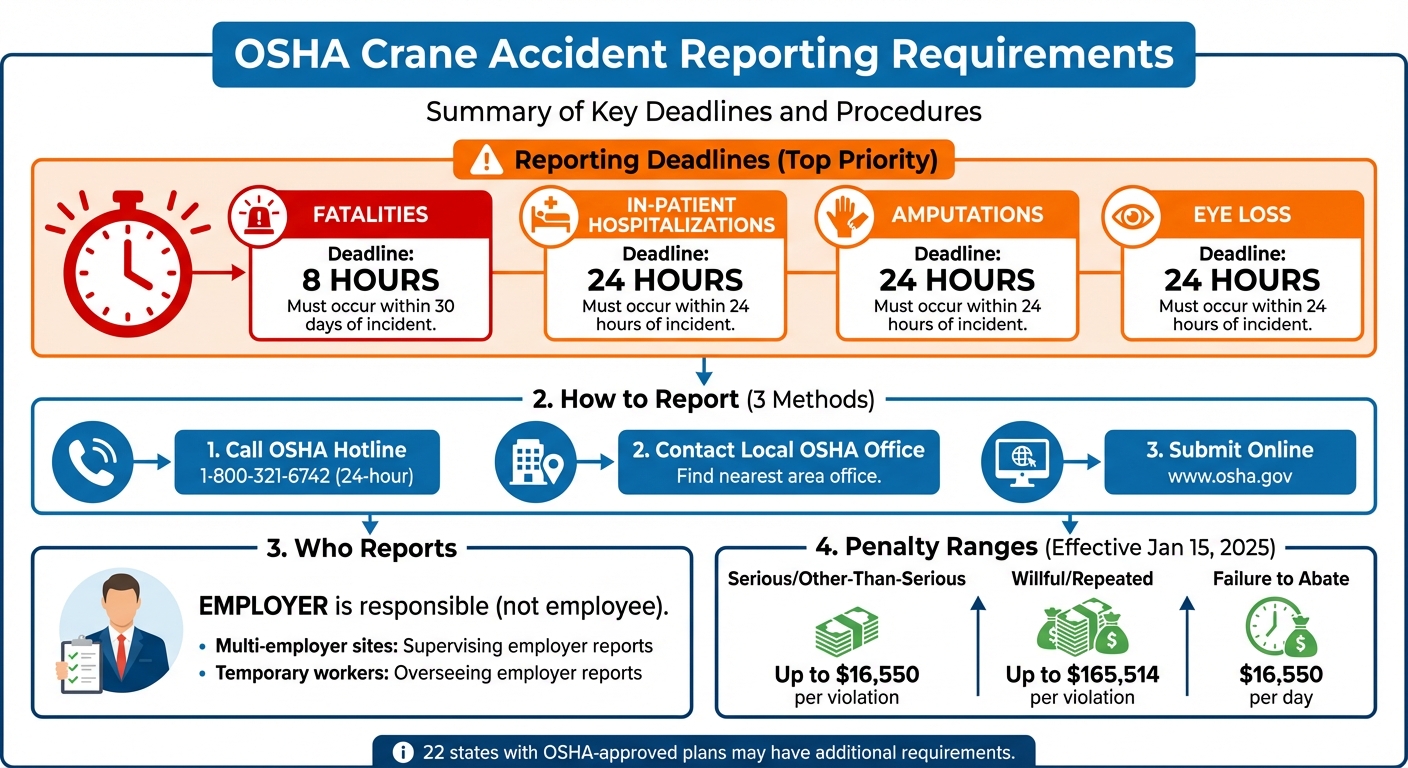
OSHA Crane Accident Reporting Requirements and Deadlines
OSHA Reporting Requirements for Crane Accidents
What Incidents Must Be Reported
Employers are required to report specific crane-related incidents, including fatalities, in-patient hospitalizations, amputations, and eye losses. However, the incident must be work-related. OSHA’s jurisdiction does not extend to injuries that occur outside the scope of employment or involve sole proprietors.
Fatalities must be reported if the death occurs within 30 days of the incident. For in-patient hospitalizations, amputations, or eye losses, the reporting window is 24 hours. OSHA defines in-patient hospitalization as a formal admission for treatment, not for observation or testing. An amputation refers to the traumatic loss of a limb or external body part, including fingertip amputations with or without bone loss. However, avulsions, deglovings, or broken teeth do not fall under this definition.
These requirements apply to power-operated construction equipment used to hoist, lower, and move suspended loads horizontally. This includes tower cranes, mobile cranes, and configured forklifts. Certain equipment, such as digger derricks for power distribution, water well drilling rigs, and articulating boom cranes used exclusively for building supply delivery under specific conditions, is exempt from the crane standard.
Reporting Deadlines and How to Report
Timeliness is critical when reporting crane-related incidents. Employers must report a work-related fatality within 8 hours of becoming aware of the incident. For in-patient hospitalizations, amputations, or eye losses, the reporting window is 24 hours. If the employer is unaware of the incident initially, the reporting clock starts as soon as the event is discovered.
| Incident Type | Reporting Deadline | Timeframe |
|---|---|---|
| Work-related Fatality | Within 8 hours | Must occur within 30 days of incident |
| In-patient Hospitalization | Within 24 hours | Must occur within 24 hours of incident |
| Amputation | Within 24 hours | Must occur within 24 hours of incident |
| Loss of an Eye | Within 24 hours | Must occur within 24 hours of incident |
Employers have three ways to report incidents:
- Call the nearest OSHA area office.
- Use the 24-hour OSHA hotline at 1-800-321-6742.
- Submit an online report at www.osha.gov.
Before reporting, ensure you have all necessary details, including the business name, names of affected employees, the incident location and time, a brief description of what happened, and a contact number.
It’s worth noting that incidents occurring on public highways or during commercial transportation are exempt unless they happen in a construction zone.
These deadlines underscore that only designated employers are responsible for filing the report.
Who Must Report the Accident
The responsibility for reporting lies with the employer. On multi-employer construction sites, the employer directly supervising the injured worker must file the report. For temporary workers, the employer overseeing them at the time of the incident is responsible for the notification.
Controlling contractors have separate obligations under 29 CFR 1926 Subpart CC. They must ensure that ground conditions are adequate for crane assembly and operation, but this does not shift the reporting duty unless they directly employ the injured worker. Similarly, crane lessors who supply operators are required to meet certain standards but are not responsible for reporting unless they are the injured worker’s employer.
Employers operating in the 22 states with OSHA-approved plans, such as California and Washington, must adhere to state-specific rules. These states often impose stricter reporting procedures or additional requirements, so it’s essential to confirm compliance with local regulations to avoid penalties.
sbb-itb-6be7c12
Construction Incident Report: When to Use and What to Include
Documenting Crane Accidents and Internal Best Practices
After ensuring timely external reporting, thorough internal documentation helps maintain compliance and provides insights for improving safety measures.
Immediate On-Site Documentation
Start by capturing all relevant details at the site as soon as possible. Record ground conditions, including any outrigger settling or water accumulation. Verify and document that the hoisting equipment stayed level throughout the operation, as this check is required after every setup. Prompt documentation not only aids internal investigations but also ensures compliance with OSHA reporting standards.
Take note of the status of safety devices like boom-angle indicators, boom stops, anti-two block devices, and load moment indicators. Inspect mechanical components carefully - check for leaks in air or hydraulic lines, confirm that wire rope reeving matches specifications, and look for any deformities in the hooks. These details are critical for investigations and can demonstrate whether the equipment was properly maintained before the incident occurred.
OSHA Forms and Record Keeping
It’s important to distinguish between reporting and recording. Recording involves logging incidents on OSHA forms within seven calendar days. Only incidents involving death, lost workdays, restricted work, medical treatment beyond first aid, loss of consciousness, or significant injuries need to be recorded.
Three OSHA forms are essential for documenting workplace incidents:
- Form 301 (Injury and Illness Incident Report): Includes detailed information about each recordable case.
- Form 300 (Log of Work-Related Injuries and Illnesses): Tracks and classifies all incidents throughout the year.
- Form 300A (Summary): Provides annual totals and must be certified by a company executive. This summary must be displayed in a visible location from February 1 to April 30.
All three forms must be kept for five years after the end of the calendar year they cover. Be mindful not to record minor incidents that only require first aid, such as diagnostic x-rays, use of over-the-counter medications, or cleaning minor wounds. Keeping records accurate and focused prevents unnecessary work and ensures compliance during OSHA inspections.
Preparing for OSHA Inspections
OSHA inspectors often request additional documentation beyond the standard forms. Make sure files are well-organized and include operator certifications, daily pre-shift inspection reports conducted by a competent person, and rigging inspection logs completed by qualified riggers. If any pre-shift inspections reveal hazards, document that the equipment was immediately removed from service until the issue was resolved.
Keep all records accessible and arranged by date. Many businesses are also required to submit Form 300A, 300, and 301 data electronically through the Injury Tracking Application (ITA) between January 2 and March 2 each year. OSHA does not accept these forms via mail or email. Maintaining accurate records and conducting regular inspections not only ensures compliance but also promotes safer working conditions.
Investigating Crane Accidents and Taking Corrective Action
When a crane accident occurs, it’s crucial to document the event and then dig into the causes to prevent it from happening again.
How to Conduct an Accident Investigation
Start by securing the accident site. This step ensures evidence is preserved and prevents further damage or injury. A thorough investigation involves several steps: gathering background details, inspecting the site, interviewing witnesses, and conducting technical analyses.
Key records to collect include maintenance logs, lifting plans, risk assessments, and certifications for operators, riggers, and supervisors. Pay attention to details like wreckage distribution, ground conditions, working radius, boom angle, outrigger extension, and counterweight status. Use photos and measurements to document these elements. Additionally, extract data from the crane’s logger to gain an objective picture of its condition before the incident.
"It is important to interview witnesses as early as possible to 'freeze' their accounts of the accident. Time and subsequent conversations with others may cause the witnesses to change their statements." – George Y.H. Yu, Principal Investigator, Universal Technology Centre
Promptly interview everyone involved in the lifting operation - the operator, riggers, signalmen, and supervisors - to get accurate accounts. Verify that all personnel meet OSHA standards: operators must be certified or deemed competent, riggers should be qualified, and signal persons must hold proper certification.
For tower cranes, review pre-erection inspection reports to ensure no damage occurred during transport or assembly. Pay close attention to critical safety devices like anti-two block devices, load moment indicators, boom-angle indicators, wire ropes, and pressurized lines.
Differentiate between the main cause of the accident and any secondary failures that followed. For instance, in the September 2013 National Art Gallery tower crane collapse in Singapore, investigators found that a loose fit (0.33 to 1.28 mm larger than standard) between the pulley and shaft caused the wire rope to snag and snap while lifting a 5,000 kg excavator.
The insights from your investigation will directly inform the corrective actions needed to address the issues.
Developing and Implementing Corrective Actions
If hazards are identified, take the equipment out of service until the problems are resolved. Address issues like misaligned control mechanisms, worn-out components, or contamination from lubricants or water. Ensure that all safety devices - such as boom-angle indicators, anti-two block devices, and load moment indicators - are fully operational.
Replace any hooks or latches that are deformed, cracked, or chemically damaged. Adjust wire rope reeving to meet manufacturer specifications. If unstable ground conditions contributed to the incident, improve the site’s support system or address water accumulation to stabilize the area. If there are concerns about an operator's competency, provide retraining and reassessment. After making mechanical corrections, a qualified professional must test the equipment to confirm it is safe to use.
| Component Category | Items Requiring Action | Required Action if Deficient |
|---|---|---|
| Control Mechanisms | Maladjustments, excessive wear, contamination | Repair, clean, or replace components |
| Safety Devices | Anti-two block devices, boom stops, load indicators | Restore functionality |
| Pressurized Lines | Hydraulic and air lines | Replace if deteriorated or leaking |
| Structural/Hooks | Hooks, latches, wire rope reeving | Replace if cracked, worn, or deformed |
| Ground Support | Outrigger pads, ground settling, drainage | Stabilize ground and ensure level setup |
Once corrective actions are in place, use these findings to refine your overall safety program.
Using Investigation Findings to Improve Safety Programs
The results of your investigation can help make your safety program stronger. Update site-specific erection plans to include protective measures, especially if safety latches on hooks have been deactivated for certain tasks. Empower operators to stop lifting operations or reject loads if safety concerns arise.
Improve rigging inspections by requiring a qualified rigger to check all equipment at the start of each shift, especially after an incident. If the accident occurs near utilities, establish a clearly marked work zone and train the crew to recognize hazards like induction and step potential. Companies such as TDS Erectors & Crane Service use these insights to ensure their OSHA-certified operators follow updated procedures and maintain the highest safety standards.
Statistics reveal that mobile cranes with lattice or telescopic booms are responsible for over 84% of crane-related fatalities, while around 11% of fatal incidents involve crane toppling. Common causes include overloading, loss of center of gravity control, outrigger failure, high winds, and poor maintenance. Use this data to focus on the most frequent failure points in your operations.
Penalties for Non-Compliance and How to Reduce Risk
Once corrective actions are in place, understanding potential penalties and taking steps to minimize risks becomes critical.
OSHA Fines and Citations
Failing to report crane accidents on time can lead to steep financial penalties. Errors in recording or missing deadlines violate 29 CFR Part 1904.
OSHA updates penalty amounts annually to account for inflation. Starting January 15, 2025, fines for a Serious or Other-Than-Serious violation can reach up to $16,550 per violation. For Willful or Repeated violations, the maximum penalty climbs to $165,514 per violation. Additionally, if hazards remain uncorrected past the required abatement date, OSHA can impose daily fines of $16,550 until the issues are resolved.
| Violation Type | Maximum Penalty (Effective Jan. 15, 2025) |
|---|---|
| Serious | $16,550 |
| Other-Than-Serious | $16,550 |
| Posting Requirements | $16,550 |
| Failure to Abate | $16,550 per day |
| Willful or Repeated | $165,514 |
Data sourced from OSHA guidelines.
If your business operates in one of the 22 states with OSHA-approved state plans, check local regulations, as they may impose stricter penalties or additional reporting requirements.
Legal and Financial Consequences
OSHA citations carry more than just monetary fines - they can lead to broader legal and financial challenges. These citations often serve as evidence in civil lawsuits, making it easier for injured workers or their families to bring claims against your company. Beyond lawsuits, citations can increase workers' compensation premiums and harm your company’s reputation, potentially jeopardizing future contracts.
In severe cases, willful violations can result in criminal charges for company executives, alongside civil penalties. OSHA’s standard of proof, "a preponderance of the evidence", means they only need to demonstrate that a violation was more likely than not to have occurred. Companies can contest citations to reduce penalties; for instance, presenting expert testimony on employee non-compliance with training protocols has led to penalty reductions of up to 75% in some cases.
Accurate and thorough documentation - covering safety training, equipment inspections, and incident reports - is your best defense during OSHA inspections or litigation.
Risk Reduction Strategies
The best way to avoid penalties is to prevent violations altogether. Designate specific personnel to handle OSHA notifications within the required 8-hour or 24-hour windows. Conduct regular internal safety audits - ideally quarterly - to identify and address training gaps or equipment issues before they escalate into reportable incidents.
Certify all crane operators through accredited third-party organizations, and ensure riggers and signal persons meet the "qualified" standards outlined in 29 CFR 1926.1427 and 1926.1428. Implement a multi-tiered inspection system with checks at the shift, monthly, and annual levels for equipment and wire ropes. Keep detailed, on-site records to demonstrate compliance during inspections.
TDS Erectors & Crane Service exemplifies these risk reduction strategies by employing OSHA-certified operators and maintaining a robust safety program. Their comprehensive approach ensures all personnel meet qualification standards and that equipment undergoes rigorous and regular inspections. Partnering with third-party OSHA compliance consultants helps them identify any overlooked gaps and strengthen their safety practices.
These measures align seamlessly with broader safety improvement efforts and build a stronger foundation for compliance and risk management.
Conclusion and Key Takeaways
Reporting crane accidents promptly plays a crucial role in ensuring workplace safety and meeting legal requirements. Timely reporting not only fulfills regulatory obligations but also initiates investigations aimed at preventing similar incidents in the future. Beyond meeting deadlines, maintaining compliance demands daily inspections by qualified personnel, verified operator certifications, and thorough safety documentation.
The stakes for non-compliance are high. Businesses risk facing steep fines, legal challenges, and rising workers' compensation costs. However, companies that prioritize regular inspections, detailed record-keeping, and dedicated personnel for managing OSHA notifications can significantly lower these risks.
TDS Erectors & Crane Service exemplifies this approach by relying on certified operators and conducting regular inspections to safeguard both workers and clients. Their safety measures include verifying operational safeguards before every shift, maintaining at least a 20-foot clearance from power lines, and coordinating with utility providers. These practices not only ensure compliance but also minimize operational risks.
Effective compliance goes beyond immediate reporting - it requires an ongoing commitment to safety improvements. Employers should utilize OSHA’s 24-hour hotline at 1-800-321-6742 or the online reporting tool to meet reporting deadlines. Empowering crane operators to halt operations when safety concerns arise is another key step in fostering a safer work environment.
FAQs
How do I report a crane accident to OSHA?
To report a crane accident to OSHA, start by verifying if the incident meets their reporting standards. OSHA mandates reports for any work-related fatality (a death occurring within 30 days of the incident) or severe injury (such as in-patient hospitalization, amputation, or the loss of an eye, occurring within 24 hours).
If the incident qualifies, notify OSHA promptly: within 8 hours for a fatality or within 24 hours for a severe injury. Reports can be made by calling OSHA’s 24-hour hotline, submitting a report online, or visiting a local OSHA office in person. When reporting, have essential details ready, including the date, time, location of the accident, and a brief explanation of what occurred. Acting quickly ensures compliance and contributes to maintaining workplace safety.
How can employers comply with federal and state OSHA crane safety regulations?
Employers can stay in line with OSHA crane safety regulations by adhering to the federal standards set forth in 29 CFR 1926 Subpart CC. These rules cover key areas like operator certification, equipment inspections, and incident reporting. For federal reporting, the deadlines are strict: fatalities must be reported within 8 hours, while severe injuries have a 24-hour reporting window. Maintaining detailed records - such as operator certifications, inspection logs, and incident reports - is a critical part of compliance.
It’s important to note that each state may have its own OSHA-approved plan, often with additional requirements. These could include specific forms, stricter penalties, or extra training mandates. To ensure compliance, employers should regularly review their state’s OSHA guidelines and incorporate any extra measures into their safety protocols. Working with companies like TDS Erectors & Crane Service, which emphasizes safety and provides OSHA-certified operators, can be a smart move. This partnership can help meet both federal and state requirements while keeping job sites as safe as possible.
What are the consequences of not reporting a crane accident to OSHA on time?
Failing to report a crane accident right away can lead to serious repercussions, like OSHA citations and civil penalties. These fines can vary widely, from a few hundred dollars to several thousand, depending on the severity of the violation and the specifics of the non-compliance.
Reporting accidents promptly isn’t just about following the law - it’s also essential for upholding workplace safety and keeping your operations running smoothly. Make sure your team understands OSHA’s reporting rules and deadlines to avoid unnecessary complications.
Related Blog Posts
Blogs, calculators, and other content on the TDS blog is for educational purposes only and does not constitute crane or rigging advice. For information specific to your situation, please contact us for an estimate or consultation.
Related Articles

Impact of Severe Weather on Crane Operations
Severe weather demands strict limits, monitoring, and shutdown plans to keep crane operations safe.
How to Calculate Crane Lifting Capacity Safely
Learn how to safely calculate crane lifting capacity by understanding key factors, reading load charts, and adhering to safety protocols.
Construction Project Safety Checker
Assess jobsite safety in minutes with a simple checklist, compliance score, and practical recommendations to address common construction risks.