
5 Signs Hydraulic Cylinders Need Replacement
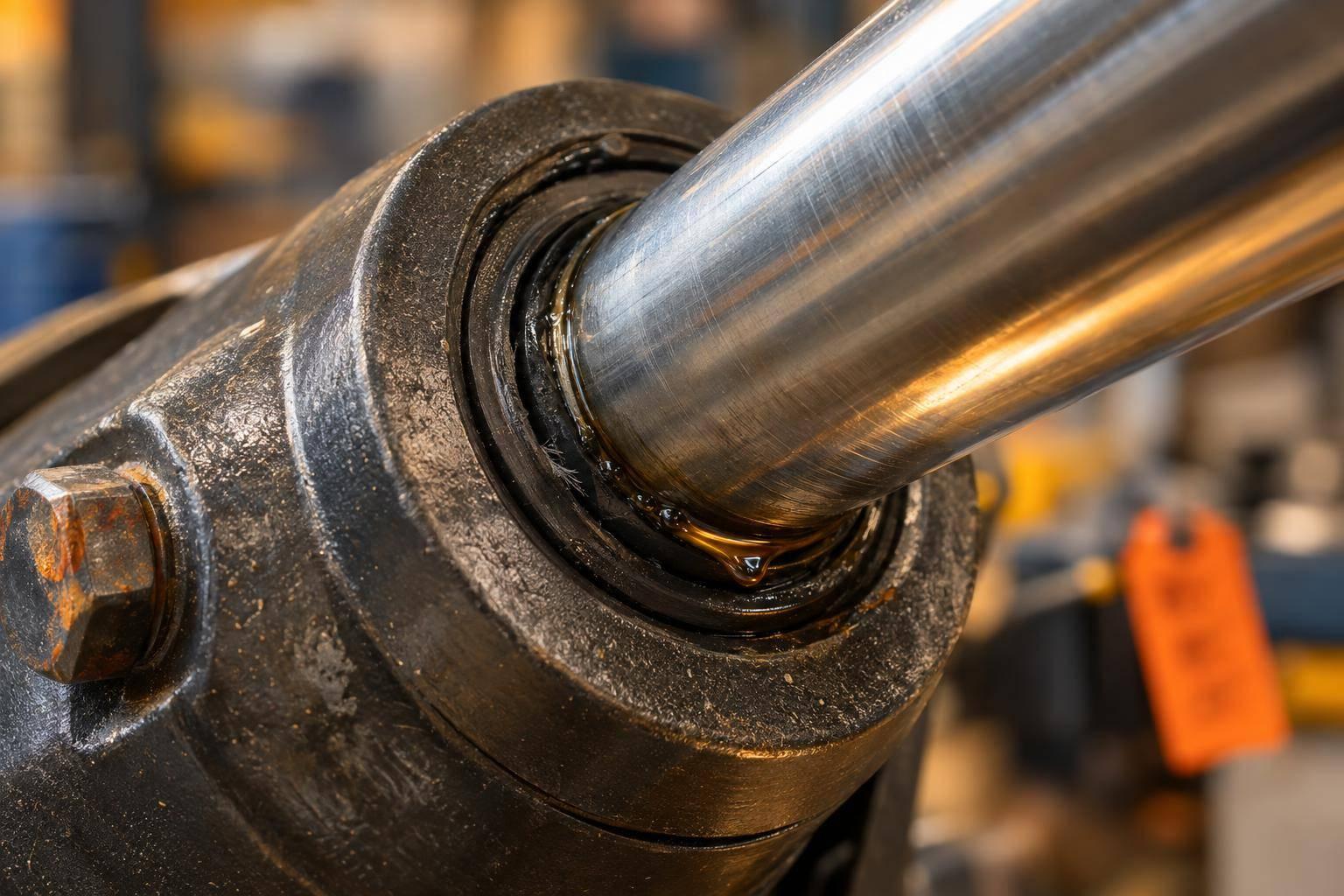
Hydraulic cylinder replacement should depend on confirmed damage - not symptoms alone. Leaks or poor movement may call for a seal repair, a replacement part, or work elsewhere in the hydraulic system.
These 5 warning signs call for inspection:
- Persistent fluid leaks
- Load drift or loss of holding power
- Slow, weak, or jerky movement
- Bent, scored, or corroded piston rods
- Structural damage or repeated failures
Remove unsafe equipment from service. Before inspection, qualified personnel should secure the load, isolate energy sources, and relieve stored pressure using approved procedures. Never check for leaks with bare hands.
Manufacturer limits guide the repair-or-replace decision. The cause must be corrected, and required safety tests completed, before the equipment returns to service.
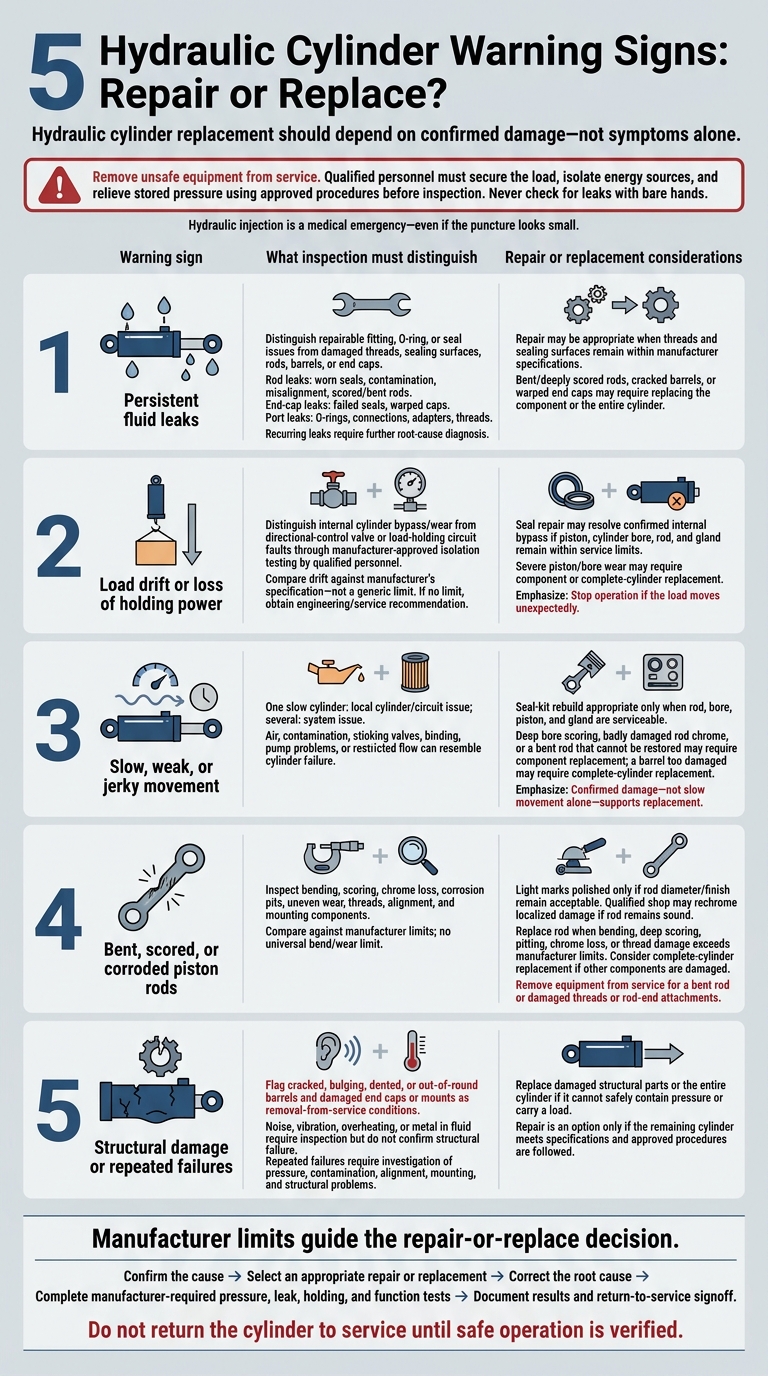
5 Hydraulic Cylinder Warning Signs: Repair or Replace?
Hydraulic Cylinder Failure: Why Seals Fail & How to Test (4K 3D)
sbb-itb-6be7c12
Before Inspection: Secure Equipment and Identify the Cause
Before deciding whether a warning sign calls for cylinder replacement, take unsafe equipment out of service. Lower the load or secure it with manufacturer-approved supports rated for both the equipment and the load. Never rely on hydraulic pressure or a control valve to hold it.
Have qualified personnel follow the manufacturer’s service instructions and your employer’s written lockout/tagout procedure. Shut off power and bleed pressure using the manufacturer’s procedure. Lock out and tag out all energy sources, then verify zero start-up, zero movement, and zero pressure. Keep checking if stored energy could build back up. Inspection can begin at the source of the symptom only after the equipment is safe.
Never check for a leak with your hands. Hydraulic injection is a medical emergency that requires immediate care - even if the puncture looks small.
Before judging the cylinder, document its model, hours, fluid type, repair history, and operating conditions. Compare pressure, dimensions, drift, and cycle times with manufacturer specs. Check the entire hydraulic system, not just the cylinder, to determine whether a leak, drift, slow movement, or rod damage comes from the cylinder or another component.
Keep inspection separate from powered testing. Any pressure or movement test requires qualified personnel, manufacturer-approved procedures, guarding, safe distances, and PPE. Stop if the load is unsecured, pressure is unverified, or the procedure is missing.
1. Persistent Hydraulic Fluid Leaks
Warning Signs
Leaks need closer attention when they return after cleaning or basic service. Watch for wet spots that reappear, drips, or oil pooling beneath the cylinder. Frequent reservoir top-offs can also signal a leak.
Possible Causes
The leak’s location helps narrow down the cause:
- Rod leaks usually point to worn seals, contamination, misalignment, or a scored or bent rod.
- End-cap leaks usually point to failed static seals or warped end caps.
- Port leaks usually point to damaged O-rings, loose connections, cracked adapters, or stripped or damaged threads.
Rod damage, warped caps, and damaged threads may need more than a seal replacement.
Diagnostic Checks
Clean and dry the suspected areas using an approved method. Then find the highest point where wetness reappears. Oil can travel along hoses or the barrel, making the leak appear farther from its source.
Finding the source helps separate a repairable seal or fitting issue from damaged cylinder surfaces. If testing is needed, follow the manufacturer’s procedure and stay in a safe position.
Repair or Replacement
Not every leak calls for replacement. A fitting, O-ring, or seal repair may stop the leak if the threads and sealing surfaces remain within manufacturer specifications.
A bent or deeply scored rod, cracked barrel, or warped end cap may require replacing the component or the entire cylinder. If the leak returns, inspect further for contamination, pressure issues, or hidden surface damage.
2. Load Drift or Loss of Holding Power
Warning Signs
Load drift happens when a lifted or positioned load moves while the control is in neutral. The cylinder can lose position even without a visible oil leak. Stop operation if the load moves unexpectedly.
The fault may be in the cylinder or the load-holding circuit. Isolate the source before replacing parts.
Possible Causes
Internal piston-seal bypass is a common cause of drift. Other cylinder faults include a worn bore, damaged piston, loose or damaged ports, or excessive rod wear.
Drift can also result from a leaking directional-control valve, a faulty counterbalance or pilot-operated check valve, contaminated fluid, incorrect relief-valve settings, or air in the circuit. Consider cylinder replacement only after isolation testing confirms internal bypass or wear.
Diagnostic Checks
Only qualified personnel should test for drift, following the manufacturer’s procedure and energy-control program. Shut down the machine, isolate energy sources, relieve residual pressure, and block or support any elevated load.
Where the circuit allows isolation, use a manufacturer-approved pressure-holding or isolation test to separate cylinder faults from load-holding circuit faults. If drift continues with the cylinder ports isolated, internal bypass or wear may be the cause. If drift stops, investigate the valve or load-holding circuit.
Record the distance and speed of movement, load condition, cylinder position, hydraulic-fluid temperature, and system pressure. Compare the results with the manufacturer’s drift specification - not a generic limit. If no published limit exists, get an engineering or service recommendation.
Use these results to determine whether the problem lies in the cylinder, valve, or circuit before choosing repair or replacement.
Repair or Replacement
A seal repair may resolve confirmed internal bypass if the piston, cylinder bore, rod, and gland are still within service limits. Severe piston or cylinder bore wear may call for component replacement or a complete cylinder replacement. If drift returns after a correct seal repair, further diagnosis is needed.
3. Slow, Weak, or Jerky Movement
Warning Signs
After checking for drift, watch how the cylinder moves under load. Look for slow travel, weak force, hesitation, vibration, or uneven extension and retraction.
One slow cylinder points toward a local cylinder or circuit issue. Several slow functions suggest a system issue. This distinction helps separate cylinder wear from pump or valve problems. Jerky or chattering motion often points to air, contamination, a sticking valve, or binding - it doesn’t prove the cylinder has failed.
Possible Causes
Worn or damaged piston seals can let oil bypass. A scored bore can damage seals and increase leakage, while a bent rod can bind in the gland. Air can make movement erratic. Contamination can restrict valve passages and wear sealing surfaces.
The next step is to determine whether the problem comes from cylinder wear or from the pump, valves, or oil flow.
Diagnostic Checks
Check pump pressure and flow against the manufacturer’s specifications. Inspect fluid level and condition, valves, filters, hoses, the suction path, and possible air-entry points.
Compare extension and retraction under approved test conditions. Use the results to determine whether the cylinder, its circuit, or both need service.
Repair or Replacement
Confirmed damage - not slow movement alone - supports replacement. A seal-kit rebuild is appropriate only if inspection confirms that the rod, bore, piston, and gland are still serviceable.
Deep bore scoring, badly damaged rod chrome, or a bent rod that can’t be restored may call for component replacement. If the barrel is too damaged to restore, the entire cylinder may need replacement. Correct the root cause before returning the cylinder to service.
4. Bent, Scored, or Corroded Piston Rods
Warning Signs
If movement problems persist, visible rod damage can help confirm a cylinder-side issue. Bent rods, damaged chrome plating, and pitted surfaces affect sealing and alignment, not just appearance.
Check for bending, deep lengthwise scoring, flaking or missing chrome, corrosion pits, uneven wear, and damaged rod-end threads. Grooves and sharp edges in the seal contact area can cut seals. Pits may remain even after surface rust is removed. Remove the equipment from service if the rod is bent or the threads or rod-end attachments are damaged.
Possible Causes
Wear on both the rod and bushing usually points to side loading rather than normal wear. Misaligned mounts, worn bushings, seized pins, or bent linkage can force the cylinder to carry sideways loads it wasn't designed to handle.
Diagnostic Checks
After the visual inspection, check rod straightness and wear against manufacturer specifications. Have a qualified technician check straightness with a dial indicator or manufacturer-approved fixture, then use a micrometer to measure rod diameter at several points and orientations.
Record runout, minimum diameter, surface damage, and thread condition. Compare every measurement with manufacturer limits - there's no universal bend or wear limit. Also inspect the gland, rod eye, pins, bushings, and mounts.
Repair or Replacement
Light surface marks may be polished if doing so doesn't affect rod diameter or finish. A qualified shop may be able to repair localized chrome damage through rechroming, provided the rod remains sound.
Replace the rod if bending, deep scoring, pitting, chrome loss, or thread damage exceeds manufacturer limits. Consider replacing the entire cylinder when damage to the barrel, gland, piston, or mounts makes repair unsuitable. Correct alignment and mounting faults, replace worn pins and bushings, and test the cylinder before returning it to service.
5. Structural Damage or Repeated Failures
Warning Signs
Damage to the barrel, end caps, or mounts goes beyond routine seal wear. Remove the cylinder from service if the barrel is cracked, bulging, dented, or out of round, or if an end cap or mount is damaged.
Noise, vibration, overheating, or metal in the fluid call for further inspection, but they don’t confirm structural failure. Structural defects usually point to overload, impact, or mounting problems - issues a seal repair can’t fix.
Possible Causes
Overloads, impacts, and misalignment can permanently damage the barrel, end caps, or mounts. Other causes include pressure spikes, corrosion, improper installation, side loading, and harsh end-of-stroke contact. Worn bushings and loose mounts also create side loads.
Repeated leaks after a correct repair point to a pressure, alignment, or structural problem that hasn’t been fixed.
Diagnostic Checks
Have a qualified technician inspect the barrel, rod, welds, end caps, ports, pins, brackets, and mounts against manufacturer limits.
Keep records of repair dates, operating hours, leak locations, and pressure readings. Before approving another repair, check relief-valve operation and fluid contamination.
Repair or Replacement
If the cylinder can no longer contain pressure or carry a load safely, replace the damaged structural parts or the entire cylinder.
Once structural damage is confirmed, repair is an option only if the remaining cylinder still meets specifications. Under that condition, replaceable bushings, pins, or a serviceable end cap may be repaired. Qualified personnel must handle any welding, machining, or pressure testing using approved procedures.
Conclusion: Let Inspection Findings Guide Replacement
Once you identify the symptom, let inspection findings guide the repair-or-replace decision. A seal repair or rod replacement may be enough if the cylinder body, rod, gland, mounts, and threads remain within manufacturer limits.
Remove equipment from service if it has structural damage, uncontrolled drift, or pressurized leaks. Before inspection, secure, isolate, depressurize, and support the equipment.
Have qualified personnel document the defect, operating conditions, and findings that support the decision. Correct the root cause before returning the cylinder to service.
Complete the manufacturer-required pressure, leak, holding, and function tests. Record the results and return-to-service signoff in the maintenance history. Do not return the cylinder to service until safe operation is verified.
FAQs
Is rebuilding my hydraulic cylinder worth the cost?
Rebuilding a hydraulic cylinder is worth the cost only when damage is minor and repairs can return it to safe, full working order that meets industry standards. If damage is severe, puts safety at risk, or cannot be repaired to meet regulatory requirements, replacement is the only safe option.
Major repairs also require a qualified professional to inspect the cylinder and perform live-load testing before the equipment returns to service. These steps add time and cost.
How do I choose the right replacement cylinder?
Choose a replacement hydraulic cylinder that meets the manufacturer’s exact specifications for your equipment’s make and model. Account for the failure symptoms, required capacity, and reach. Never use an improvised part or skip requirements to meet a deadline.
Unsure which cylinder to choose or how to install it? Contact TDS Erectors & Crane Service for replacement guidance and help returning your equipment to safe, full operation in line with industry standards.
How can I prevent repeat cylinder failures?
Inspect hydraulic lines daily before lifts for wear, damage, and leaks. Document findings with photos, follow the manufacturer’s maintenance schedule, and keep logs of maintenance and replacements.
After repairs or adjustments, require an inspection by a qualified person and functional testing before restarting. A cleared alarm does not mean restart approval.
After a breakdown, record the root causes and update maintenance procedures and training. Use follow-up reviews and retraining to verify that the changes work for the specific scenario and equipment configuration.
Related Blog Posts
Blogs, calculators, and other content on the TDS blog is for educational purposes only and does not constitute crane or rigging advice. For information specific to your situation, please contact us for an estimate or consultation.
Related Articles
Troubleshooting Overhead Crane Electrical Problems
Safety-first, step-by-step guide to diagnose and fix overhead crane electrical faults—power checks, control tests, motors, VFDs, and logging.
OSHA Safety Standards Analyzer
Ensure OSHA compliance with our free Safety Standards Analyzer. Identify gaps in your construction site safety measures and get actionable fixes fast!

Study: Load Stability in Multi-Crane Lifting Operations
Multi-crane lifts fail when planned load share drifts—maintain accurate geometry, matched rigging, synchronized moves, and live hook/outrigger monitoring.