
Study: Load Stability in Multi-Crane Lifting Operations
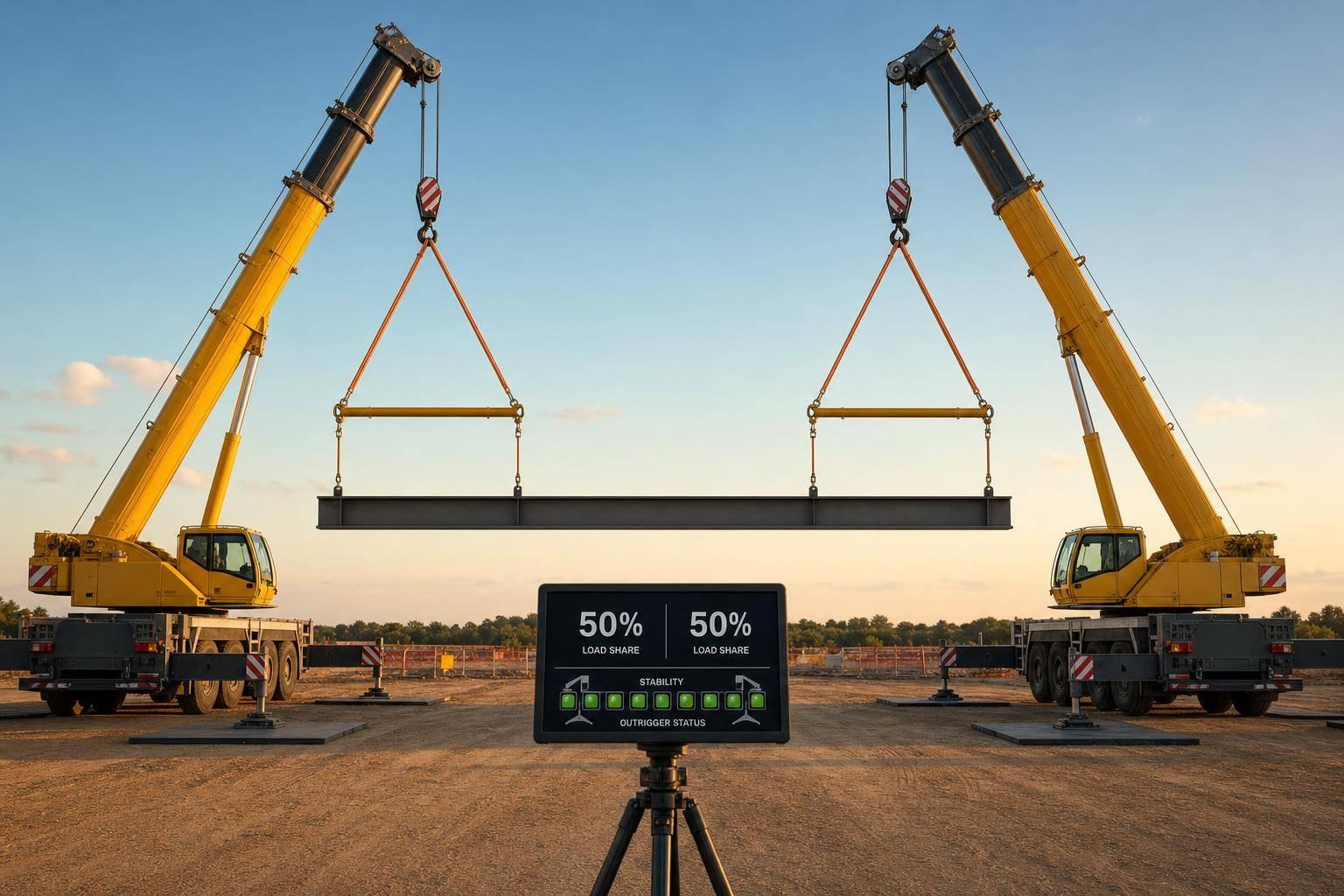
A multi-crane lift can fail even when each crane looks fine on paper. The main issue is load share: if one crane takes more weight than planned, stability can change fast.
Here’s the short version:
- Load share is based on geometry, not a 50/50 guess
- A small mismatch in hook height, sling length, crane speed, or ground support can shift weight from one crane to another
- Set-down is one of the highest-risk moments because one crane can unload before the other
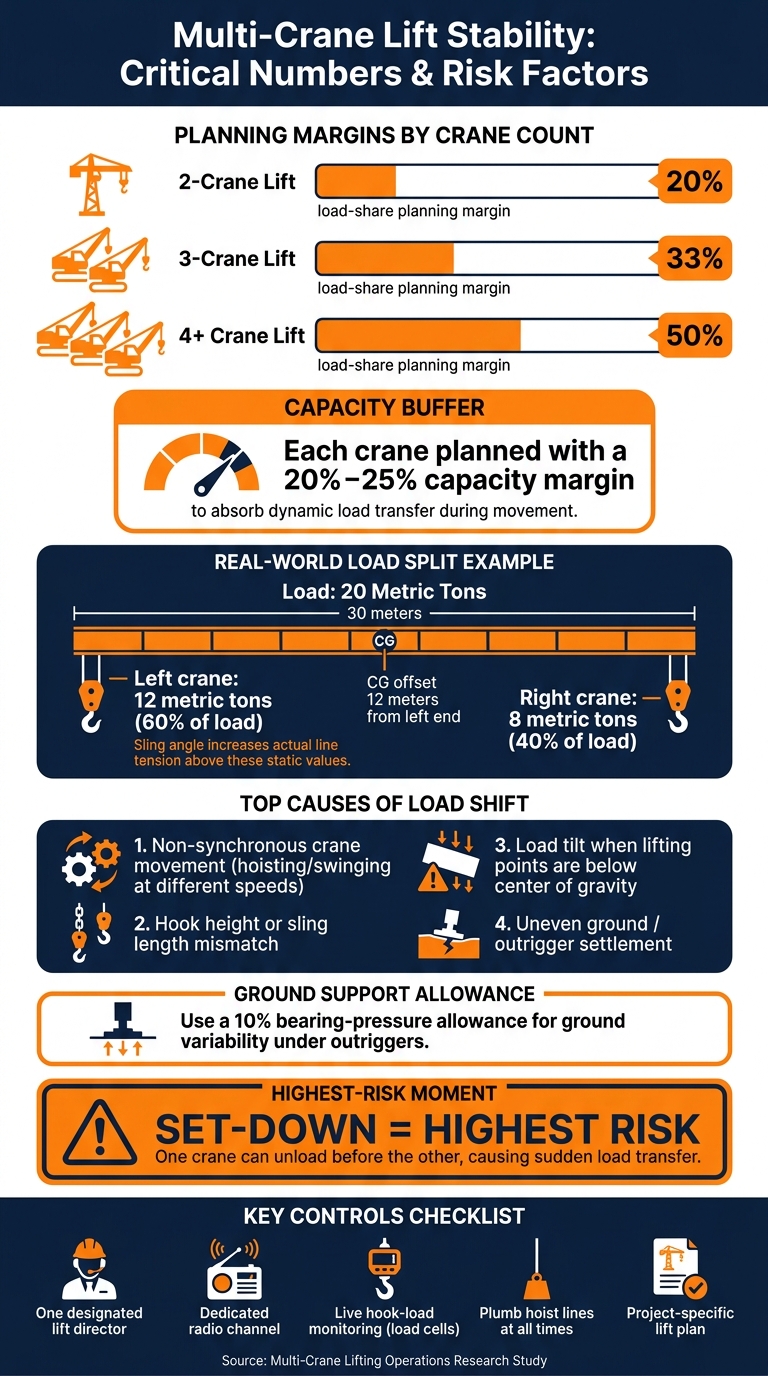
- Planning margins matter: many sources use 20% for two-crane lifts, 33% for three-crane lifts, and 50% for lifts with four or more cranes
- Capacity buffer matters too: each crane is often planned with a 20% to 25% margin
- Ground support can change the lift; some guidance uses a 10% bearing-pressure allowance
- Live monitoring and one lift director help keep both cranes moving together
One example from the research shows why this matters. A 20-metric-ton load on a 30-meter beam did not split evenly. With the center of gravity offset, one crane took 12 metric tons and the other took 8 metric tons before sling angle added more line tension.
If I had to reduce the study to one plain takeaway, it would be this: <u>multi-crane stability depends on keeping the planned load share matched to what is happening in the field</u>. That means accurate calculations, matched rigging geometry, synchronized movement, plumb hoist lines, and close watch on hook loads and outrigger reactions.
The rest of the article explains how research ties load stability to center of gravity, pick points, rigging setup, movement control, and ground conditions across jobs in Arkansas, Texas, Oklahoma, Louisiana, and Tennessee.
Multi-Crane Lift Load Sharing: Key Safety Margins & Risk Factors
Mobile Cranes and Multi-Crane Lifts - ITI

sbb-itb-6be7c12
How Studies Measure Load Sharing Between Cranes
Multi-crane load sharing is a geometry problem, not a simple 50/50 split. Recent studies calculate each crane’s share from the lift geometry, not from the number of cranes in the lift. That matters because load sharing affects stability: it shows which crane is likely to hit its limit first.
Center of Gravity, Pick Points, and Rigging Geometry
Load distribution depends on several connected factors: total weight, CG location, pick-point spacing, sling length, hook height, and the weight of the below-hook rigging. If one hook is higher or one sling is shorter, that crane can take more of the load. In one published example, a 20-metric-ton load on a 30-meter beam with the CG 12 meters from one end split 12 metric tons to the near crane and 8 metric tons to the far crane, before sling angle increased line tension above the static load share.
That calculated split is the starting point for planning, not the final field result.
Equal vs. Unequal Load Sharing in Field Conditions
Once the lift moves from paper to the jobsite, the actual split can drift from the planned one. Equal load sharing happens only under a tight set of conditions: the pick points must be the same distance from the CG, sling lengths must match, and hook elevations must be identical. If any of those change, the loading becomes unequal.
When the CG is offset, the crane closer to it carries more weight. That’s why a flat 50/50 assumption can be risky in a two-crane lift. It can make the demand on one crane look lower than it will be in practice. To deal with that, many guidance sources add planning margins above the calculated share:
- 20% for two-crane lifts
- 33% for three-crane lifts
- 50% for lifts with four or more cranes
These load-share estimates set up the stability risks that come next.
Key Stability Risks Found in Multi-Crane Lift Research
Recent research shows that the biggest risks in a multi-crane lift tend to show up during execution, not just in the plan. Once the load leaves the ground, force distribution can keep changing as the cranes pick, swing, travel, and set the load down.
Dynamic Load Transfer and Non-Synchronous Movement
The main danger isn’t the planned load split on paper. It’s what happens once the load starts moving. A major cause of instability is non-synchronous movement - when one crane hoists, swings, or travels even a little faster than the other. That can push more weight onto one crane, increase rigging tension, or briefly unload the other hook.
Set-down is the most critical moment. One crane can unload faster than the other, and that can shift the load before the crew has time to correct it. In plain terms, the load share can spike past the planned limit in a matter of moments.
Side Loading, Load Tilt, and Ground Reaction Changes
Non-synchronous movement often shows up as side loading and tilt. Side loading happens when the hoist line is no longer vertical. That cuts capacity and adds lateral stress to both the crane and the rigging. In a tandem lift, this can come from unequal crane positioning, load rotation during the swing, or travel paths that don’t keep the load directly under both hooks.
Load tilt is another problem. It can happen when one crane lifts higher than the other or when the rigging geometry shifts during the swing. Once that geometry changes, the load can tilt and the load share can change fast. The load is inherently unstable when lifting points sit below the center of gravity; even a small disturbance can cause sudden rotation and a sharp load transfer between cranes. A slight height mismatch may be all it takes to start that rotation.
As the load share moves, outrigger reactions move with it. If the ground under one crane is softer or unevenly compacted, that crane may settle a bit. That small settlement can change rigging geometry and shift the load in ways the lift plan didn’t allow for. Use a 10% bearing-pressure allowance to account for field variability. Also, monitor outrigger reactions through the full lift, not just at the start.
Planning and Control Methods That Support Lift Stability
Lift Plans, De-Rating, and Capacity Allowances
Load share can shift while the load is moving. So the plan can't live ONLY on paper. It has to guide the lift as it happens.
Start with the calculated load share, then confirm the final lift geometry and ground conditions before execution. Each crane should be planned with a 20% to 25% capacity margin. That buffer helps cover dynamic load transfer during movement, when one crane can take more load than expected for a moment.
A dry run is also worth doing. It can reveal boom interference, radius changes, and ground support problems before the actual lift begins.
Communication and Monitoring During the Lift
Once the lift is underway, control comes down to clear direction and live load feedback. One designated lift director should issue all commands to both operators. That keeps the move coordinated and cuts down on mixed signals at the worst possible time.
It also helps to use:
- Dedicated radio channels
- Standardized signals
- Live hook-load tracking through load cells or crane computer systems
Watch the hoist lines closely. Each line should stay plumb. If a line starts to tilt, that's a sign of side loading.
The same controls matter on industrial jobs across the 4-state region, where even small timing or geometry mistakes can affect stability fast.
Conclusion: Key Takeaways for Safer Multi-Crane Lifts
The research lands on one plain rule: multi-crane lifts go wrong when the planned load share no longer matches what’s happening in the field.
Recent studies show the same pattern. Safe multi-crane lifting depends on accurate load-share calculations, synchronized movement, and constant monitoring of hook load and outrigger reactions. It also works best when the entire lift follows one lift plan, not a patchwork of on-the-fly decisions.
Training is the next control point. Why? Because a well-coordinated crew can catch small geometry changes before they turn into load shifts. TDS Erectors & Crane Service stresses role-based training and OSHA-compliant procedures for office staff, service crews, and operators.
In the 4-state region, this matters most during critical lifts, where timing, load balance, and ground conditions all need to stay lined up. For critical lifts across the 4-state region, OSHA-certified operators, matched equipment, and a project-specific lift plan help put these findings to work.
FAQs
Why doesn’t a multi-crane lift split the load evenly?
A multi-crane lift almost never shares the load evenly. In the field, conditions change all the time, and those changes affect how much weight each crane is carrying.
A few things drive that shift: crane position, the rigging setup, and the load’s center of gravity. Even if the lift starts in balance, it can change fast once the load is in the air.
Wind, ground conditions, outrigger settings, load shape, and even small differences in movement or timing between cranes can push more force onto one crane than another. That’s why these lifts demand tight coordination and careful engineering.
What makes set-down the riskiest part of the lift?
Set-down is the riskiest part because that’s when stability is the hardest to hold. At the end of a lift, even small mistakes in load weight, rigging, load-center position, or real-time balance can make the load shift or start to swing.
Conditions can change, too, and that adds more risk. Ground stability under outriggers matters a lot during final placement. If the ground settles or the setup is even slightly off, safe capacity can drop fast.
How can crews spot load transfer before it becomes dangerous?
Crews can catch load transfer problems early with real-time monitoring and solid operator judgment. Load-monitoring systems help flag changes in load distribution and stress as conditions shift.
If wind, ground stability, or load movement points to lower stability, the operator should stop the lift, secure the load, and reassess. TDS Erectors & Crane Service stresses this safety-first approach through trained, OSHA-certified operators.
Related Blog Posts
Blogs, calculators, and other content on the TDS blog is for educational purposes only and does not constitute crane or rigging advice. For information specific to your situation, please contact us for an estimate or consultation.
Related Articles
Heavy Equipment Load Capacity Checker
Check if your equipment can handle a load with our free tool. Input weight, select type, and get instant safety results for forklifts and more!
Wind Speed Limits for Crane Operations
Wind thresholds, measurement tips, and manufacturer-based stop-work rules to keep crane lifts safe in gusty conditions.
Crane Safety in Emergency Evacuations
Understanding crane safety during emergencies is crucial to prevent accidents and ensure effective evacuations at construction sites.