
OSHA Standards for Load Engineering Compliance
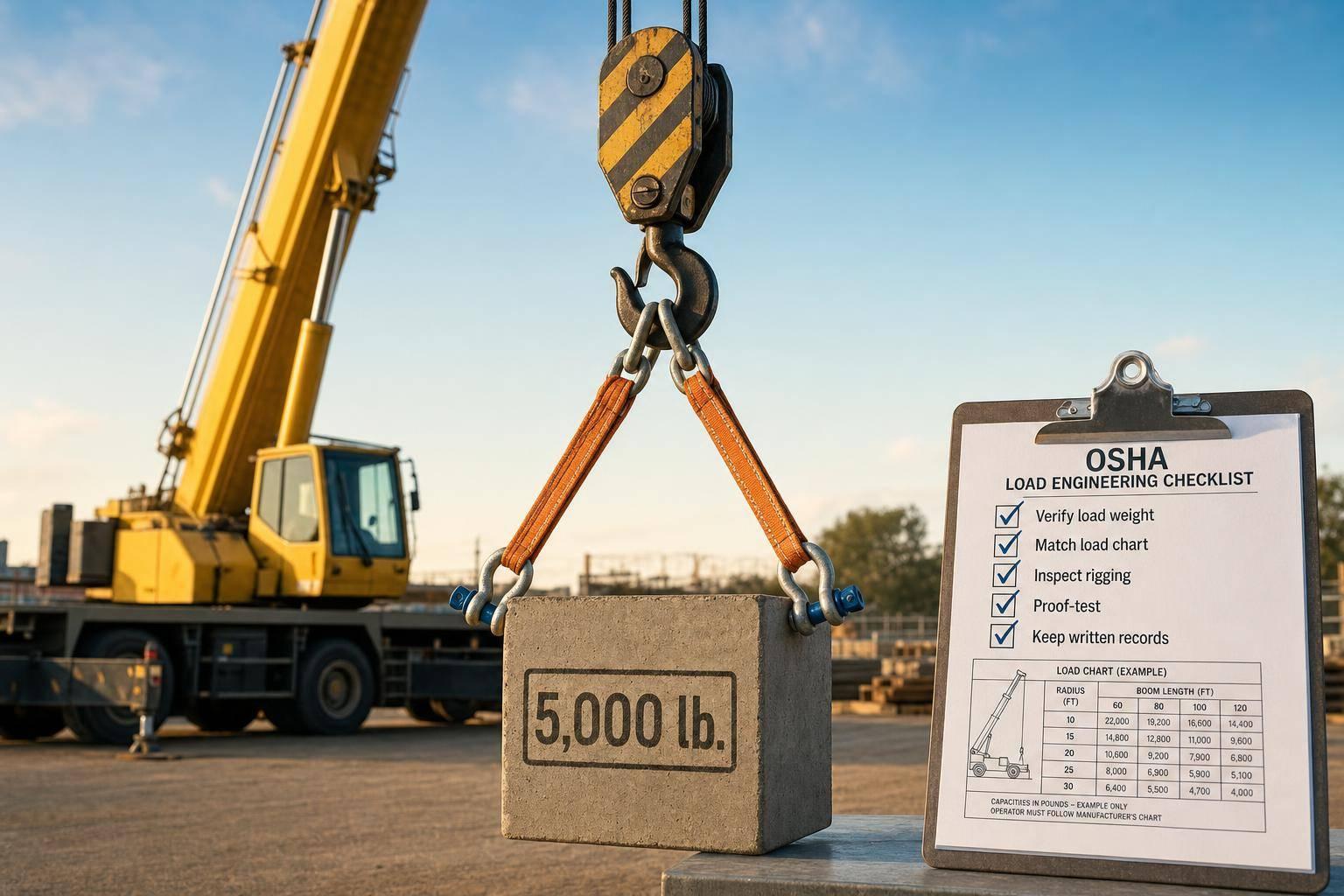
If a lift goes past rated capacity, OSHA can cite it fast - and the cost can reach $16,550 per serious violation or $165,514 per willful or repeated violation as of 01/2025.
I’d sum this article up like this: verify the load, match the load chart to the exact crane setup, inspect the crane and rigging before use, and keep written records. That is the core of OSHA load engineering compliance.
Here’s the short version of what matters most:
-
Use the right OSHA standard
- 29 CFR 1926 Subpart CC for cranes and derricks in construction
- 29 CFR 1910.179 for overhead and gantry cranes
- 29 CFR 1910.184 for slings
-
Know the load numbers before the lift
- Rated load
- Gross load
- Load radius
- Net lifting capacity
- Proof load
-
Do the lift math the right way
- Start with the crane’s chart for the exact setup
- Subtract hooks, blocks, slings, and other gear
- Check radius, boom length, outriggers, and ground support
- For some structural-capacity cases, OSHA says load weight must be checked within 10%
-
Plan higher-risk lifts in writing
- Two-crane lifts need extra review and crew briefing
- Lifts near crane limits need tighter controls
- Loads above rated limits need manufacturer or RPE approval first
-
Test and inspect
- Mobile cranes: proof test to 110%
- Overhead/gantry cranes: proof test to 125% unless the maker sets less
- Pre-shift visual checks and rigging inspections are part of the job
- Damaged slings and hooks must come out of service
-
Keep records
- Inspection date
- Inspector signature
- Equipment ID
- Load-test reports ready to show
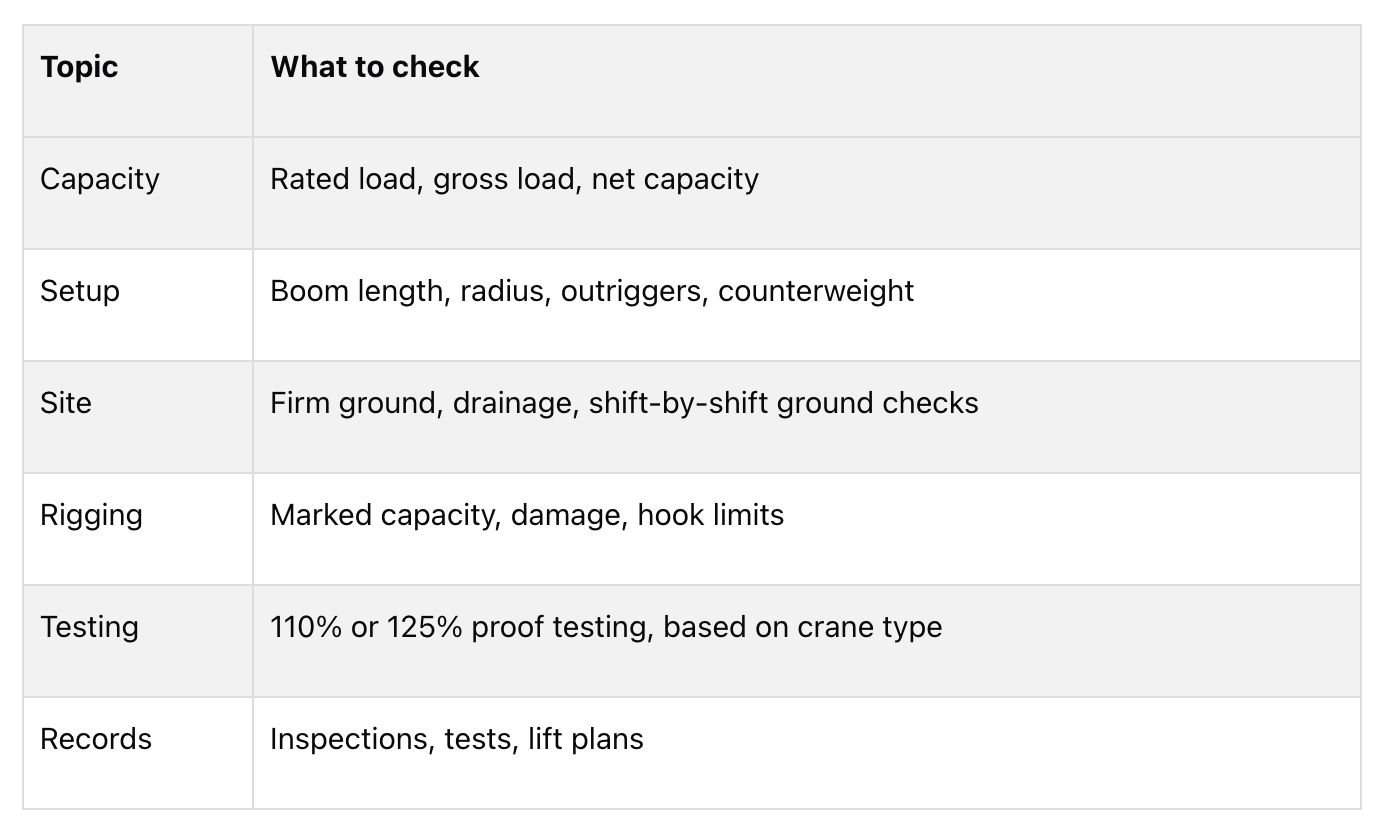
Bottom line: I’d treat load engineering compliance as a field control issue, not just a paperwork issue. If the numbers, setup, ground, rigging, and records all line up before the lift, you cut the chance of citations, delays, and equipment damage.
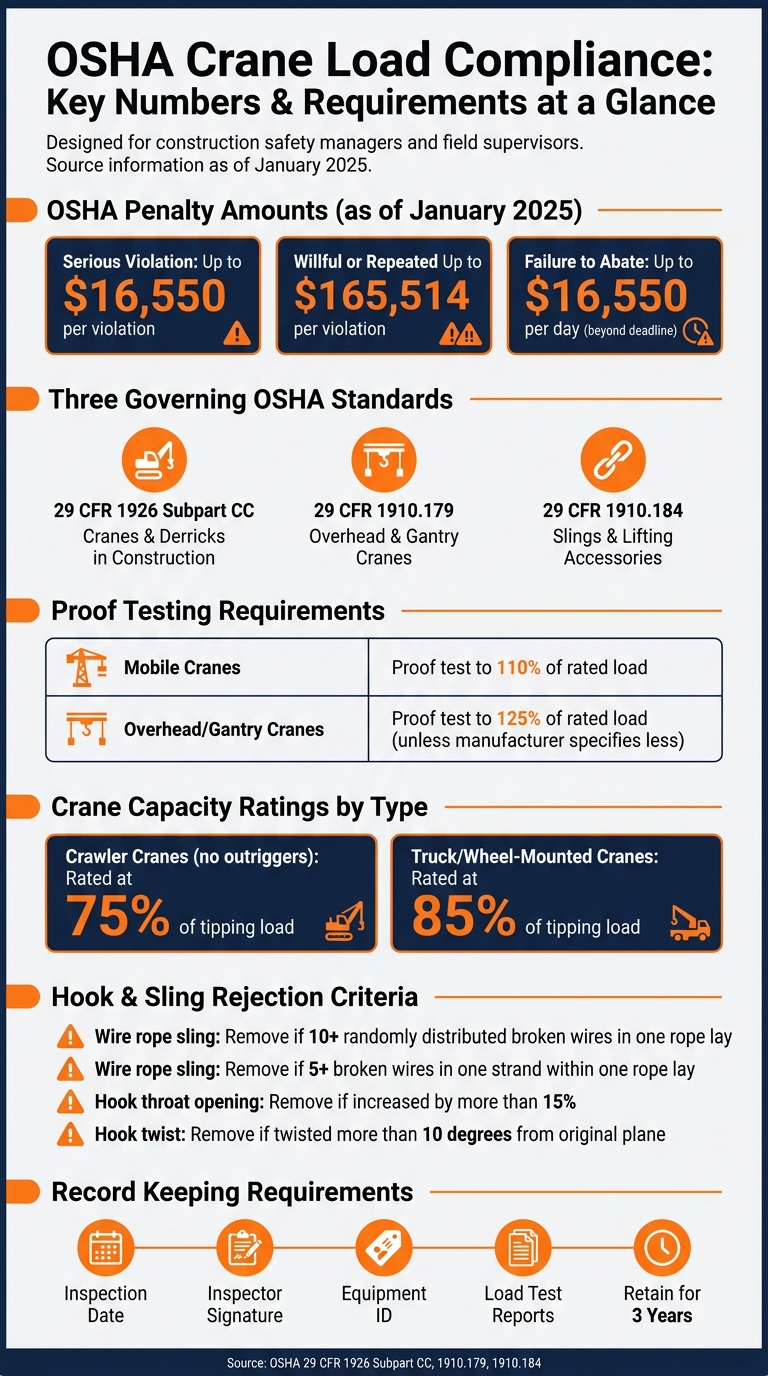
OSHA Crane Load Compliance: Key Numbers & Requirements at a Glance
Crane Inspections: OSHA Requirements & Safety Tips for Construction
sbb-itb-6be7c12
The OSHA Standards That Directly Govern Load Engineering
With the main load terms in place, the next step is looking at the OSHA rules that control how those numbers get used. On U.S. jobsites, most load calculations and lift-planning calls tie back to three OSHA standards. Rated load, gross load, and radius aren't just vocabulary terms. They're the exact numbers these rules control. If you want a lift program that meets OSHA, you need to know which standard applies to your job and what it says.
Cranes and Derricks in Construction: 29 CFR 1926.1400–1926.1442
29 CFR 1926 Subpart CC is the main OSHA standard for mobile, crawler, tower, and articulating cranes used in construction. It covers the lift itself: crane setup, equipment configuration, rated capacity, and what the operator has to do during the lift.
A few parts matter most for load calculations and lift planning. The crane's load charts and other rated-capacity information have to stay in the cab during operation. Before a lift starts, the operator must confirm the load weight using a verified source or a direct calculation based on dimensions and material density. And the load chart has to match the crane's actual boom length, radius, and outrigger setup.
This standard also covers ground conditions. The controlling entity must make sure the ground is firm, drained, and stable enough to support the crane under manufacturer specs. A competent person must check ground conditions every shift, especially after rain or groundwater buildup.
"Procedures related to the capacity of the equipment must be developed and signed by a registered professional engineer familiar with the equipment." - 29 CFR 1926.1417(b)
That same focus on capacity limits and inspection shows up again with overhead cranes and rigging.
Overhead Cranes, Slings, and Lifting Accessories: 29 CFR 1910.179 and 1910.184
These standards apply to fixed overhead or gantry cranes and the slings used with them.
29 CFR 1910.179 says all new and altered overhead cranes must be tested before first use. Test loads can't exceed 125% of the rated load unless the manufacturer says otherwise. The rated load must be plainly marked on each side of the crane. If a crane is modified or re-rated, a qualified engineer or the equipment manufacturer must review the changes and the supporting structure for the new rated load before that change is allowed.
29 CFR 1910.184 deals with slings, including alloy steel chain, wire rope, metal mesh, and synthetic types. Every sling must have a permanent, legible marking that shows its rated capacity. Damaged gear has to come out of service at once. For wire rope slings, removal is required when there are 10 or more randomly distributed broken wires in one rope lay, or 5 broken wires in one strand within one rope lay. Hooks also have clear rejection limits. If the throat opening has increased by more than 15%, or the hook has twisted more than 10 degrees from its original plane, it must be removed from service.
OSHA sets those baseline rules, but many of the finer technical points come from outside engineering standards.
How ASME and Other Engineering Standards Support OSHA Compliance
OSHA doesn't stand alone here. It brings in several consensus standards by reference, which gives those documents direct regulatory force.
For mobile cranes made on or after November 8, 2010, certain sections of ASME B30.5-2004 apply, especially the parts covering load ratings and mechanisms. For overhead cranes installed after August 31, 1971, the design must meet ANSI B30.2.0-1967. And for equipment made on or after September 19, 2001, certain sections of ASME B30.2-2005 are enforceable.
These referenced standards fill in the technical details OSHA leans on for compliant lifting. They connect straight to the calculations, lift plans, and tests used in the field.
Applying OSHA Rules to Load Calculations, Lift Planning, and Testing
Reading Load Charts and Calculating Net Lifting Capacity
Once you know which OSHA standard applies, the next job is turning that rule into numbers you can use in the field.
Start with the rated capacity listed for the exact crane setup in use. That includes boom length, boom angle, operating radius, and the outrigger or counterweight setup. Treat that chart value as your starting point, not the final answer.
"Count all auxiliary devices - hoist blocks, hooks, slings, and spreader bars - in the load." - OSHA Standard 1910.180(c)1(e)
So the math is simple in principle: subtract the total weight of the rigging and lifting gear from the manufacturer's rated capacity. What you have left is the net lifting capacity.
Setup changes matter too. A crane's rating isn't one fixed number across all conditions. For example, crawler cranes without outriggers are rated at 75% of tipping load, while truck and wheel-mounted cranes are rated at 85%. And if the lift is governed by structural capacity, OSHA says the load weight must be checked to within 10% before the lift.
Planning Engineered and Critical Lifts
As the lift gets closer to the crane's limit, basic chart reading isn't enough. At that point, you need a written engineered lift plan.
If two or more cranes are used to hoist one load, OSHA requires a designated person to review the operation, figure out crane position and rigging, and brief everyone involved before the lift begins. That's a big deal, because multi-crane lifts can go sideways fast if even one part of the setup is off.
OSHA also draws a hard line on load limits. If the planned working load goes beyond the manufacturer's rating or the crane's original design limits, the lift can't move ahead unless the manufacturer or a registered professional engineer (RPE) approves it first. For more involved lifts, a written pre-lift review should cover crane positioning, rigging, and crew instructions.
Proof Testing, Inspections, and Record Keeping
Planning is only part of the job. You also have to test, inspect, and keep records that show the equipment is fit for use.
Proof-test rules depend on the crane type and whether the equipment is new, repaired, or altered. Mobile cranes must be proof-tested to 110% of rated load. Overhead and gantry cranes must be tested to 125%, unless the manufacturer sets a lower limit. These tests apply to new equipment and also after major repair or alteration, before the crane goes back into service.
"OSHA requires rated load testing for new and altered cranes prior to their initial use to ensure that any significant problems or errors made during the repair or installation process would be revealed prior to placing the crane in operation." - Richard E. Fairfax, Director, Directorate of Enforcement Programs
OSHA also requires inspection records for key items like brakes, crane hooks, and ropes. Those records must show:
- The inspection date
- The inspector's signature
- A serial number or other equipment identifier
Written load test reports must be kept on file and made readily available to appointed personnel. On top of that, cranes need a visual inspection from a competent person before every shift. That inspection includes control mechanisms, safety devices, hydraulic lines, hooks, and ground conditions. Rigging equipment must also be inspected before each shift by a qualified rigger.
The Cost of Non-Compliance: Safety Risks, Delays, and OSHA Penalties
Once the rules are clear, the next step is simple: what does noncompliance cost on the jobsite?
Common Load-Related Failures That Trigger OSHA Citations
Most load-engineering citations trace back to a short list of mistakes that could have been avoided: miscalculated loads, unstable ground, defective rigging, and skipped inspections or retests.
Overloading is the fastest route to both a citation and a serious safety risk. OSHA requires employers to verify load weights instead of leaning on operator experience alone.
Ground conditions matter just as much. Uneven or unstable soil can tip a crane even if the lift is still within rated capacity.
Citations also come from poor sling selection, missing safety latches, skipped pre-shift checks, and putting damaged equipment back into service without the required test .
These errors don't just sit in a report. They stop work, damage equipment, and bring OSHA into the picture.
OSHA Penalty Amounts and Project-Level Costs
OSHA fines are only one part of the hit. Load-engineering violations can get expensive fast. As of January 2025, OSHA penalty amounts are:
- Serious violation: up to $16,550 per violation
- Willful or repeated violation: up to $165,514 per violation
- Failure to abate: up to $16,550 per day beyond the deadline
For contractors running more than one crane, the same paperwork mistake across several units can stack penalties, with one penalty per crane. That adds up fast.
And the money doesn't stop with the fine. If there is an overload event or suspected structural damage, work must stop at once until the equipment is cleared. That kind of pause can throw off the schedule, lead to rework, and spark contract disputes. Missing inspection records or incomplete load test documentation can also be used as evidence of noncompliance.
Building a Load Engineering Compliance Program Aligned with OSHA
Core Elements of a Compliant Lifting Program
Once the lift math, planning, and testing are in place, the next job is making sure crews carry that plan out the same way in the field every time.
Before each lift, document the load weight, rigging, crane setup, radius, lift path, and ground conditions. Then classify the lift as either standard or critical. Multi-crane lifts, personnel hoisting, power-line work, and lifts near crane capacity should be treated as critical lifts. Those lifts need a written engineered plan with drawings, and a qualified person must review it, sign it, and control it.
Inspections need the same level of discipline. Keep a documented inspection schedule, and pull defective gear from service at once. If a crane is new, altered, or repaired, require proof testing before it goes back into service. Keep lift plans and inspection records for at least three years, and make sure electronic copies are available on site.
How Experienced Crane Support Strengthens Compliance
This process works better when lift planning and field execution come from one team that’s on the same page.
TDS Erectors & Crane Service supports compliant lifts with OSHA-certified operators and task-specific equipment planning. Operator competence should be documented for the exact equipment and tasks involved, and that evaluation should be repeated when the equipment or job duties change.
When the same OSHA-aligned approach guides both rigging selection and equipment operation, paperwork gets cleaner, handoffs get simpler, and mistakes are less likely.
Conclusion: The Load Engineering Practices That Matter Most
A compliant program only works if the same steps happen on every job, every time. Match the OSHA standard to the lift, keep capacity margin, verify each calculation, inspect rigging before use, and document every critical lift.
FAQs
Which OSHA standard applies to my lift?
The OSHA rule you need depends on the type of crane you use and the kind of work you're doing.
For construction, the main rule is 29 CFR 1926 Subpart CC. That includes 1926.1433 for design and testing, plus 1926.1435 for tower cranes.
For general industry, 29 CFR 1910.179 covers overhead and gantry cranes. If the work involves steel erection, 1926.753 applies.
TDS Erectors & Crane Service recommends checking your equipment requirements closely so your setup meets the full OSHA rules.
What counts against crane lifting capacity?
A crane’s lifting capacity depends on how the machine is set up. A few things can reduce that limit, including boom length, jib installation, counterweight setup, operating radius, and boom angle.
OSHA also says the crane’s work area, outrigger or stabilizer deployment, and ground stability must match the manufacturer’s approved load chart. That’s because each of those conditions changes how much the crane can lift safely.
When is a written lift plan required?
OSHA requires a written lift plan for critical lifts. That includes any lift where the load reaches 75% or more of the crane’s rated capacity.
A written plan is also required for:
- personnel platform operations
- multi-crane lifts
- lifts near hazards such as power lines or unstable structures
- certain load testing after equipment repairs or modifications
TDS Erectors & Crane Service provides OSHA-certified operators to help support safe, compliant operations.
Related Blog Posts
Blogs, calculators, and other content on the TDS blog is for educational purposes only and does not constitute crane or rigging advice. For information specific to your situation, please contact us for an estimate or consultation.
Related Articles
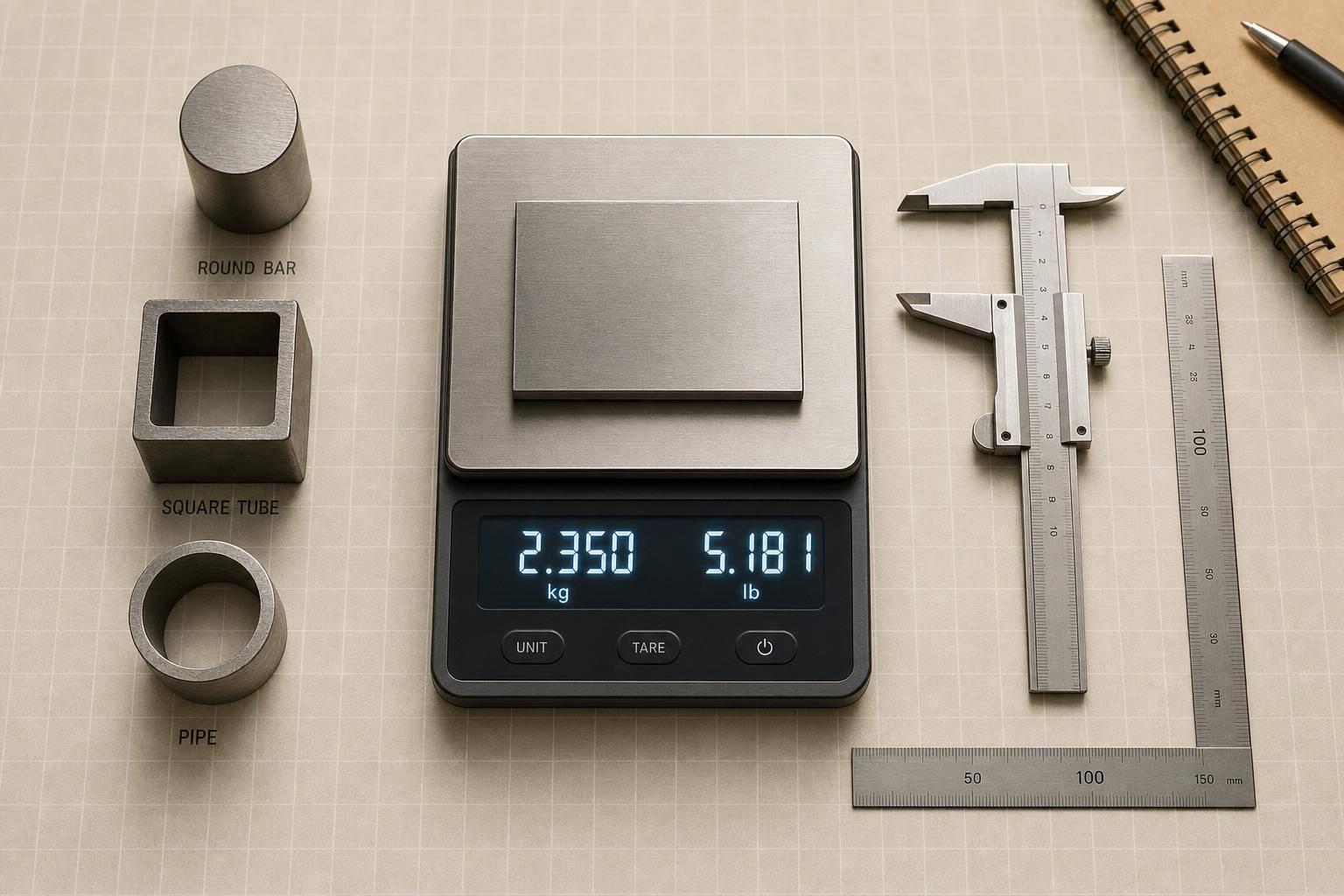
Steel Weight Calculator
Calculate steel weight fast for bars, plate, pipe, tube, and more. Get per-piece and total weights in lb and kg with clear unit handling.

Best Practices for Welding Inspection Safety
Welding inspection safety guide covering PPE, LEV ventilation, pre-weld checks, NDT, and OSHA-compliant hot-work and emergency procedures.

Top 7 Heavy Equipment Rental Mistakes to Avoid
Avoid costly mistakes in heavy equipment rentals with essential tips on equipment selection, maintenance, operator training, and contract management.